Most important takeaways…
- Fresno has 3,310 medical assistant jobs at $48,810 median pay.
- Community college MA graduates earn over $30,000 within one year.
- MA employment is projected to grow 15 percent from 2023 to 2033.
Compare accredited certificate and degree programs, costs, and career outcomes near Fresno
Fresno's medical assistant pipeline has tightened noticeably as Community Health System, Kaiser Permanente, and Saint Agnes expand outpatient capacity across the Central Valley. Federal data show roughly 3,310 MA jobs in the metro with a median medical assistant salary near $48,810, and local employers increasingly favor candidates who arrive already certified through the CMA, RMA, CCMA, or California-specific CMAC pathway.
That demand has produced a crowded training market. Fresno-area students can choose between 8-to-12-month certificates at community colleges and medical assistant trade schools, adult education programs through Fresno Adult School, or two-year associate degrees that layer in general education credits. Tuition swings from about $1,300 a year at a public college to well over $15,000 at private programs, and completion rates vary widely between them.
Fresno is the healthcare employment hub of California's Central Valley, and medical assistants are one of the most consistently in-demand roles in that ecosystem.
The major employer names you will see again and again include Community Health System (formerly Community Medical Centers), Kaiser Permanente Fresno, Saint Agnes Medical Center, now part of Trinity Health, UCSF Fresno, and Clinica Sierra Vista. Fresno also pulls patients from Clovis, Madera, Visalia, Hanford, and Merced, which keeps clinics and specialty offices busy throughout the metro.
Live hiring in 2026 backs that up. Kaiser has posted on-call medical assistant roles paying $36.34 to $38.23 per hour, though those typically require about six months of experience or a Kaiser externship. Saint Agnes and other Trinity Health sites had multiple openings in 2026, including internal medicine, orthopedics, and night positions. United Health Centers, Clinica Sierra Vista, and Regional Hand Center all list active MA jobs, with Regional Hand Center specifically noting it is growing. Other frequent Fresno employers include Fresno Nephrology, Sierra Pacific Orthopedics, Omni Women's Health, Sante Health, Expedite Urgent Care, and Concentra.
Population growth and an aging Central Valley patient base are shifting more care into outpatient clinics, urgent care centers, and specialty practices. That shift is the main reason one Fresno job search in 2026 surfaced more than 500 medical assistant postings, with 50 or more visible on a single tracker. Pay reflects the range: ZipRecruiter's average is around $19.75 per hour, while Cardinal Health posts $21.00 to $25.51, Inspire Health posts $21.25 to $24.45, and Kaiser's call-in roles reach the high $30s.
California does not require medical assistants to hold a state license. MAs work under physician supervision and can perform both clinical and administrative tasks. That makes the field accessible, but it does not mean certification is optional. Fresno-area employers increasingly expect CMA, RMA, or CCMA credentials, and national certification is the quickest way to stand out in a steady but competitive hiring market.
The typical path from enrollment to employment takes about 8 to 24 months depending on whether you choose a certificate or associate degree. California does not require state licensure for medical assistants, but national certification is strongly preferred by Fresno employers.

Fresno-area students weighing medical assistant training usually compare two main routes: a focused certificate that leads to work quickly, and an associate degree that adds general education credits. Certificate programs tend to be shorter and more affordable, while associate degrees can build a stronger foundation for future career moves or transfer into a bachelor's program. If you want to start earning as a clinical medical assistant in Fresno clinics, medical offices, or outpatient centers as soon as possible, the certificate path is often the practical choice. If you may want more upward mobility later or plan to pursue nursing or healthcare administration, the associate degree may be worth the extra time.
| Certificate | Associate Degree |
|---|---|
| 9 to 12 months | 18 to 24 months |
| About 30 to 40 credits | About 60 credits or more |
| Core clinical and administrative medical assistant skills | Medical assistant skills plus general education and advanced coursework |
| Lower total tuition because you take fewer units | Higher total tuition because of added general education units |
| Readies you for CMA, RMA, CCMA, or CMAC exams | Also readies you for national exams and includes broader study |
| Faster entry into local medical assistant jobs | Credits may transfer toward a related bachelor's degree later |
If you can't drop income entirely, look for Fresno programs with evening, weekend, or hybrid schedules so classes and clinical hours fit around your job rather than forcing a choice.
A certificate can get you working in 8 to 12 months, while an associate degree takes longer but adds general education credits that support later career moves or transfer options.
Ask which local clinics, hospital systems, or specialty practices host students, since a strong local placement pipeline can turn your externship directly into a job offer.
CMA, RMA, and CCMA aren't interchangeable, so confirm the program aligns with the credential your target Fresno employer prefers before you enroll.
How much does a medical assistant program cost in Fresno? The short answer is that it ranges from roughly $1,300 in annual tuition and fees at a public community college to about $3,000 for a short private certificate, and significantly more at some private career colleges. The number you actually pay depends on financial aid, residency, program length, and any extra fees for books, uniforms, certification exams, or background checks.
Fresno City College, the main public option, charges $46 per unit for California residents in 2025-2026, plus a $21 health fee and a $2 student representation fee.1 Its standard annual cost-of-attendance budget lists $1,332 in tuition and fees. Non-residents pay $335 per unit, so out-of-state students should calculate a much higher total.2 CALRegional's Fresno medical assistant program is $2,995 or less, and it advertises interest-free payment plans.3 Some other private career schools serving the Fresno area can cost well into five figures once all charges are added, so do not assume all private programs are priced alike. UEI College Fresno and Milan Institute Fresno also operate in the area, but their 2025-2026 tuition and fee details were not available in the research reviewed for this guide; call them directly for current quotes.
Net price is the amount left after grants and scholarships. Recent federally reported estimates for Fresno-area programs put the typical net price around $5,000 at Merced College, $8,100 at Fresno City College, and $27,900 at San Joaquin Valley College-Visalia. Treat those as approximate averages, not guaranteed quotes. Your own aid offer may be higher or lower depending on income, dependency status, and the program you enter.
Start with the FAFSA, even if you think you will not qualify. Fresno City College data shows a very high share of students receive Pell Grants, so need-based aid is common. Community college students can also apply for the California College Promise Grant, which may cover enrollment fees for eligible residents. Private schools often have their own payment plans; CALRegional, for example, offers interest-free monthly payments. When comparing schools, ask for a written list of all required costs beyond tuition, including uniforms, malpractice insurance, lab fees, and exam prep.
A fast track medical assistant program can cost more per month even if the total sticker price looks similar because it compresses training into a few months. A community college associate degree typically costs less overall but takes longer, which delays full-time income. Run the math on both monthly cash flow and total debt before choosing.
Finally, remember that published prices change. Private schools often adjust pricing by cohort, and public fees are set annually. Always call the admissions or financial aid office and request a current, itemized tuition and fee sheet before enrolling.
Accreditation is a program-level quality check that looks specifically at medical assistant training programs. When a Fresno school says its medical assistant program is accredited by CAAHEP or ABHES, it means an outside organization has reviewed the curriculum, instructors, and clinical requirements against national standards. That matters because certification bodies often use accreditation status to decide who can sit for their exams.
CAAHEP is the Commission on Accreditation of Allied Health Education Programs. ABHES is the Accrediting Bureau of Health Education Schools. Both focus on health career training, but they are separate from the general college accreditation that covers a school's degrees and federal financial aid. For medical assistant students, CAAHEP and ABHES are the names to look for.
Some programs may hold both accreditations, and some certification boards accept more than one route, so verify your specific path.
CMAC is California's state-specific Medical Assistant Certification. It can be useful for demonstrating knowledge of California scope-of-practice and documentation rules. In Fresno job postings, national credentials such as CMA (AAMA), RMA (AMT), and CCMA (NHA) are the most commonly listed, so a clear comparison of medical assistant certification exams can help you choose the right one. CMAC may be accepted alongside one of those, but it is less often requested as a standalone credential in the region. Treat it as a supplement unless a specific employer tells you otherwise.
Accreditation can lapse, and a program may have been accredited in the past without holding current status. Before signing an enrollment agreement, ask the program directly for its current accreditation letter and check the CAAHEP or ABHES directory yourself. If a school says certification eligibility is included, ask which credential and which exam route that applies to.
Classroom learning versus hands-on patient care: a medical assistant program has to deliver both, and the balance between the two shapes how prepared you'll feel on your first day at a clinic. Whether you enroll at Fresno City College, CALRegional, Sanger Adult School, or elsewhere, expect the medical assisting course curriculum to move through anatomy and physiology, medical terminology, pharmacology basics, phlebotomy, EKG administration, electronic health records, and insurance billing and coding before you ever touch a real patient.
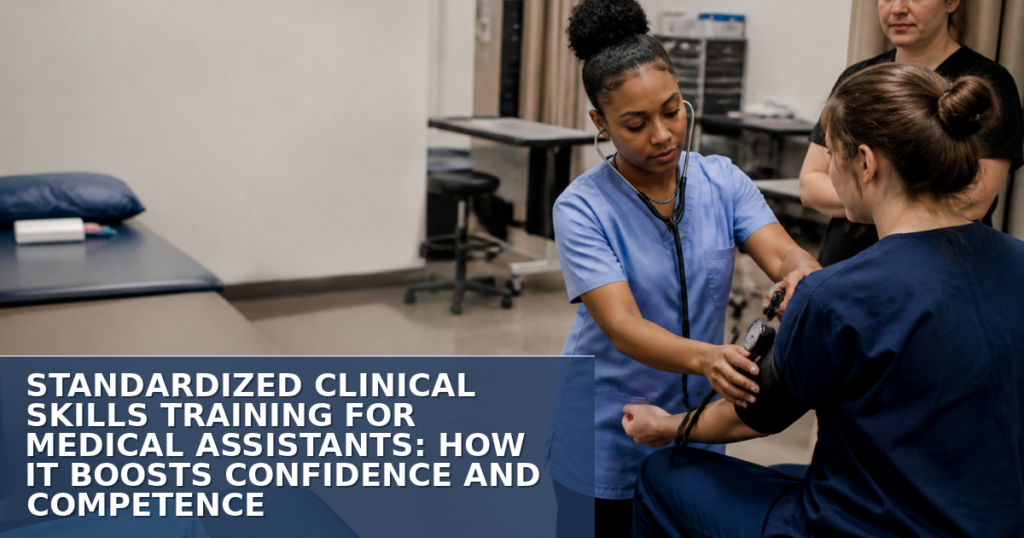
Most programs build in a simulated clinical lab where you practice injections, vital signs, and specimen collection on classmates or mannequins. This is where you make your early mistakes safely, before you're standing in front of a patient at an actual clinic. It's also where instructors catch technique problems early, which matters once you're being evaluated by supervising staff during your externship.
Clinical hour requirements differ across Fresno-area programs, and it's worth asking each school directly for current medical assistant externship hours rather than assuming they're identical. Sanger Adult School structures its clinical medical assistant training as 160 classroom hours paired with a 160-hour externship, plus a national certification exam and CPR credential at the end.1 CALRegional similarly guarantees a 160-hour externship placement into a real clinical environment.2 Fresno City College's certificate track uses a work-experience course near the end of the program, connecting students with physician offices and clinics the college already partners with3, though published hour totals for this course have varied between terms4, so confirm the current figure when you enroll.
The associate degree path at Fresno City College folds in general education, English, math, and psychology, alongside a cooperative work-experience component that students help coordinate with faculty.5 That means more time in school overall, but also a broader academic foundation. A certificate in medical assisting skips the general education requirement and moves more directly toward the externship, which suits students who want to reach the workforce sooner.
Fresno medical assistant graduates from community college programs earn a median of just over $30,000 within their first year in the field. That number typically climbs steadily as they gain hands-on experience and add certifications like the CMA or RMA to their resume.
Federal labor data show about 3,310 medical assistant jobs in the Fresno metro area in 2025. Median pay was $48,810 per year ($23.47 per hour). Local wage estimates from O*NET put the 10th percentile at $37,300 and the 90th percentile at $70,660, while the national outlook projects 12 percent growth from 2024 to 2034.
| Metric | Value |
|---|---|
| Total employment, Fresno metro area (2025) | 3,310 |
| Median annual wage | $48,810 |
| Median hourly wage | $23.47 |
| 10th percentile annual wage | $37,300 |
| 25th percentile annual wage | $38,920 |
| 75th percentile annual wage | $50,900 |
| 90th percentile annual wage | $70,660 |
| Projected job growth, national (2024-2034) | +12% |
Below are the top medical assistant programs serving Fresno-area students, ranked by IPEDS completion data, accreditation status, and program fit. Each profile highlights credential type, campus or hybrid format, net price, graduation rate, and certification exam preparation where available.
Fresno, CA · $8,000/yr (net price)
Best for: Central Valley students wanting hybrid training
Fresno City College is a public community college in central Fresno, making it a practical choice for local students. The Medical Assisting program offers both an Associate in Science and a Certificate of Achievement, with hybrid delivery and a clinical medical assistant focus. The institution's graduation rate is 23.5%, and in-district students can plan around a net price of about $8,100. The campus is easy to reach from Clovis, Madera, and Sanger, and published materials do not name a single national certification exam, so check with the program about CMA, RMA, or CCMA eligibility.
Visalia, CA · $28,000/yr (net price)
Best for: Visalia-area students seeking hands-on clinical certificate
San Joaquin Valley College in Visalia offers a campus-based Clinical Medical Assisting certificate that can be completed in as few as nine months. The program prepares students for both the RMA and CCMA exams and includes hands-on training in blood draws and pharmacology. The institution's graduation rate is 36.5%, with an approximate net price of $27,900. It is a reasonable commute for students in Visalia and south Fresno County, though longer from Clovis and Madera.
Merced, CA · $1,000 – $9,000/yr
Best for: Merced commuters preferring public community college
Merced College is a public community college in Merced offering a short-term Medical Assistant Certificate on campus. The curriculum combines administrative and clinical medical assisting with courses in office occupations and skills acquisition. The institution's graduation rate is 35.7%, and the net price is about $5,000. The campus is accessible from Merced and the northern Central Valley, but farther for students in Visalia or Fresno.
According to the Bureau of Labor Statistics Occupational Outlook Handbook, employment of medical assistants is projected to grow 15% from 2023 to 2033. That pace is much faster than the average for all occupations, making this one of the strongest growth outlooks in healthcare support.
Medical assistant training in Fresno comes in several formats and price points. These answers cover cost, legal requirements, scheduling, and online options so you can compare programs with confidence.
Costs vary widely and are not always directly comparable. CalRegional lists a total program cost of $2,995 or less,1 while Fresno State Continuing and Global Education lists an online clinical medical assistant with externship at $3,950.3 Agape College lists $8,527.50, and UEI College lists $19,900.2 Check what each price includes, such as books, scrubs, kits, and fees.
No state license or degree is required.4 You can work as a medical assistant without certification in California, but most Fresno employers typically expect some formal training, a certificate, or on-the-job preparation rather than a degree. Fresno area programs commonly offer certificate-level training, and associate degree pathways also exist, such as through Fresno City College. The practical requirement is usually employer preference, not a state mandate.
There is no single best school for every student, because cost, speed, format, and placement support all matter. CalRegional stands out for affordability and day, evening, or weekend schedules. UEI College stands out as a traditional career school with a published Fresno campus and current start dates. Fresno City College and Fresno State CGE offer related pathways, but published graduation, exam pass, and job placement comparisons are limited.
Yes. CalRegional states that classes may be offered during the day, evening, or weekend depending on location.5 UEI College Fresno has campus hours Monday through Thursday until 8:00 PM, which supports evening medical assistant classes.2 Check with each program about the exact schedule for the current term, since availability can vary by cohort and location.
Some online or hybrid options are available. Fresno State Continuing and Global Education lists an online clinical medical assistant program with a clinical externship,3 and Sanger Adult School describes a hybrid course that is half online and half in person.6 Even when coursework is online, expect hands-on lab or externship requirements, since clinical skills need in-person practice.