Building a Hospital Medical Assistant Program: A Practical Guide
A step-by-step employer playbook for building an in-house medical assistant pipeline.
By Jennifer GubblerReviewed by Editorial StaffUpdated August 25, 202615 min read
Most important takeaways…
Hospital medical assistant employment will grow 12 percent from 2024 to 2034.
Employers may receive wage subsidies for registered medical assistant apprenticeships.
Central New Mexico Community College runs a one-year paid Medical Assistant Apprenticeship.
Medical assistant employment is projected to grow 12 percent from 2024 to 2034, with roughly 112,300 openings per year, yet many hospitals still cannot fill MA roles through outside hiring alone. A hospital-based medical assistant training program is a direct response: hire trainees, pair them with mentors, and cover evening classes so they earn while completing clinical hours for certification.
The route can be a registered apprenticeship, an in-house pathway, or a college partnership, each with different accreditation, funding, and recruitment trade-offs. Because many aspiring medical assistants cannot afford an unpaid medical assistant externship, paid models fill seats faster and produce candidates familiar with hospital workflows.
Why Hospitals Are Building Their Own Medical Assistant Pipelines
Poaching certified medical assistants from nearby clinics versus building hospital medical assistant training programs from within: for many hospital workforce planners, the second option is becoming the durable answer.
The Hiring Math Has Changed
Competition for certified MAs has made external recruiting expensive and unreliable. Hospitals that depend on luring already credentialed staff often lose them to the next higher offer. An employer-sponsored medical assistant training pipeline lets a hospital fill entry-level roles with people who are already learning the facility's workflows, culture, and patient population from day one.
A One-Year Paycheck Instead of Unpaid Training
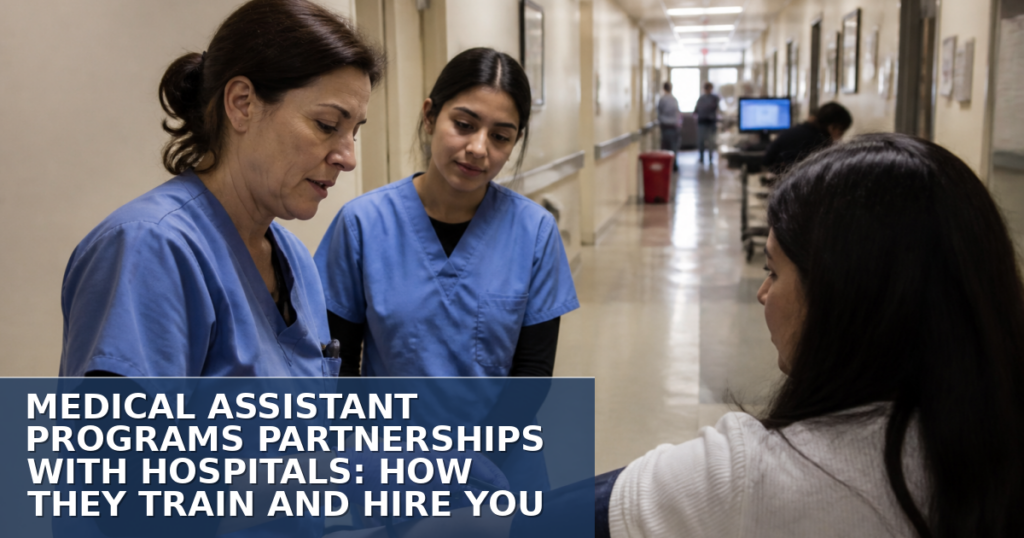
The registered Medical Assistant Apprenticeship Program at Central New Mexico Community College, highlighted by Albuquerque Business First in August 2026, shows the model in practice.1 Employers hire apprentices and provide experienced mentors while those apprentices complete evening classes and paid on-the-job learning. The program pays for and registers apprentices for required classes, and completion leads to the Registered Medical Assistant (RMA) certification through American Medical Technologists (AMT). Instead of waiting for a graduate to finish school, the hospital gets a contributing employee who is earning while learning. As CNM Senior Program Manager Jessica Nojek put it, "Many students need to work and earn a living wage while they are going to school."
Employer Incentives and Equity
The structure carries direct financial benefits for employers. Hospitals may qualify for wage subsidies to offset apprentice salary costs. At the same time, paid training expands who can realistically pursue certification. The program is currently seeking healthcare employers interested in hiring apprentices, which gives hospitals a turnkey way to launch or expand a pipeline without building curriculum from scratch. Nojek also stressed the equity impact: "This expands the equity of who can achieve this certification while also getting their foot in the door with a local employer." For hospitals, that means a wider, more diverse applicant pool and a more stable entry-level workforce.
Choosing a Program Model: Apprenticeship, In-House Training, or College Partnership
Hospitals can choose a Department of Labor registered apprenticeship like the Central New Mexico Community College (CNM) model, a hospital-run in-house training path, or a formal college partnership such as Edison State Community College and Wilson Health. Apprenticeships and college partnerships align more directly with recognized certification routes, while in-house training offers maximum control but requires more employer-built curriculum and may depend on the AMT work experience route.
Dimension
Registered apprenticeship
In-house hospital training
College partnership
Structure
Employer hires the apprentice, provides a mentor, and pays for on-the-job learning; CNM offers evening classes so apprentices earn while they train.
Hospital designs and delivers its own clinical and administrative curriculum, often using staff educators and internal rotations without a college partner.
College supplies classroom instruction while the hospital supervises paid on-the-job training; example: Edison State Community College and Wilson Health.
Typical length
One year (CNM registered Medical Assistant Apprenticeship Program).
No standardized length in available sources; duration is set by the hospital.
Traditional college MA programs require at least 720 total instruction hours including 160 externship hours for the AMT education route.
Employer cost burden
Employer pays wages; the program pays for and registers apprentices for required classes; wage subsidy may offset salary costs.
Employer typically carries wages and curriculum development costs; no uniform tuition or subsidy figure in researched sources.
Announcement indicates shared training responsibilities but does not specify employer wage costs, tuition sponsorship, or subsidy amounts.
Wage-subsidy eligibility
Yes, employers may be eligible for a wage subsidy to help offset salary costs.
Not standardized; may depend on local workforce board grants or specific program structure.
Not stated in the Edison State and Wilson Health example; eligibility likely depends on whether the partnership is registered as an apprenticeship.
Certification pathway
Complete a U.S. Department of Labor registered, AMT-approved apprenticeship and pass the AMT RMA exam.
If the in-house program is not accredited or DOL-registered, employees may need to use the AMT work experience route after 3 years of full-time MA employment with clinical and administrative duties.
Graduate from an accredited MA program (720 hours including 160 externship) within 4 years and pass the AMT RMA exam.
Most aspiring medical assistants can't afford to work unpaid clinical hours while paying rent. Offering a paid apprenticeship instead of a traditional externship removes that financial barrier, widens your applicant pool, and signals that your hospital values workers from day one, a real recruitment and equity edge.
Curriculum, Certification, and Accreditation: The Non-Negotiables
A 24-week minimum program length is one of the few fixed numbers in medical assistant accreditation, and it applies to programs seeking ABHES approval. That baseline matters because a hospital-based program that cuts corners on clinical exposure will leave trainees unprepared to sit for the RMA, CMA, or CCMA exam.
Credential Pathway: Program, Clinical Hours, Exam
Here is the sequence to design toward. First, the trainee completes an accredited or state-approved medical assistant program that combines didactic coursework with supervised clinical experience. Second, the program must document those clinical or externship hours in a way an accreditation body will accept. Third, the graduate becomes eligible to apply for a national credential such as the RMA through American Medical Technologists, the CMA through the AAMA, or the CCMA through the NHA. Individual certification is separate from program approval.
Verifying Accreditation: CAAHEP vs. ABHES
Hospital and employer-sponsored programs can pursue accreditation through CAAHEP or ABHES. CAAHEP reviews medical assisting programs through its committee, MAERB, using competency-focused standards effective April 4, 2022. ABHES explicitly includes hospital-based, employer-sponsored, and federally-sponsored training programs among eligible program types and requires enrollment, student progress, and clinical experience. To verify a program, check the CAAHEP/MAERB listing or ABHES directory rather than relying on a school's marketing claim.
Clinical Hours and Externship Alignment
CAAHEP standards do not state a universal numeric clinical-hour minimum in accessible program documents, so hospital programs should align clinical hours to the competencies the exam tests, not chase a magic number. ABHES requires an externship and a minimum 24-week full-time program length, with didactic and externship combined, and expects enrolled students to have completed at least 50% of the program or 25% of core coursework for certain progress reviews. State approval bodies may add their own mandates; confirm those directly. Before launching, ask whether your state requires a separate education license or approval for an employer-based clinical training site. If a hospital's existing MA job duties do not match the program's required competencies, the employer must build deliberate learning rotations rather than treating on-the-job time as automatic clinical training.
Accreditation vs. Certification
Program accreditation clears the institution. Individual certification clears the person. A hospital can run a fully accredited program, but each graduate must still pass the national exam to earn the RMA, CMA, or CCMA credential. Keep those two gates separate in planning, budgeting, and recruiting.
What a Hospital-Based MA Program Looks Like Week by Week
Hospital-based medical assistant training usually moves through five phases: onboarding, classroom and lab modules, paid on-the-job learning, certification exam preparation, and transition into a full clinical role. Clinical hour requirements vary, but many programs build in 160-200 hours of supervised practice.
Funding Options: Grants, Workforce Boards, and Wage Subsidies
Most hospital-based medical assistant training budgets are built from three layers: public workforce dollars, a college partner, and the employer’s own payroll. The biggest public source is WIOA Title I, which carries about $2.919 billion in PY2026 formula allotments across youth ($948.13 million), adult ($875.6 million), and dislocated worker ($1.096 billion) activities.1 That is not reserved for medical assistants, but it is the first place many hospitals look. Although current proposals are flat to slightly reduced from FY2024 levels, the funding stream remains active.2
WIOA and Workforce Board Partnerships
Local workforce boards decide how WIOA dollars are spent, so hospitals should start there rather than with a federal agency. Eligible costs can include tuition, books, supplies, and supportive services for programs on the state’s eligible training provider list.3 Some boards also reimburse medical assistant on the job training wages, commonly up to 50 percent, but there is no single national rate. Participant eligibility usually requires being 18 or older, having a GED or high school diploma, and being unemployed or underemployed.3 Because local allocations are not broken out by occupation, hospitals need to ask their board directly about how to get a grant for medical assistant training. State and local boards often layer additional healthcare or medical assistant grants on top of formula WIOA, though availability varies widely.
Apprenticeship Wage Subsidies
State-level apprenticeship grants can offset the salary side directly. New Jersey’s GAINS program, for example, reimburses up to 50 percent of an apprentice’s wages, capped at $12,000 per apprentice over 52 weeks, with a starting wage of at least $18 per hour unless a justification is accepted. That structure reduces the cost of paying an apprentice while they complete classroom hours and supervised clinical work. Hospitals typically access these funds by partnering with a registered apprenticeship sponsor or workforce board rather than applying as a standalone grant. Asking the state apprenticeship office about active wage reimbursement rounds is usually the fastest entry point.
Three Budget Models
Fully employer-funded: Highest control and fastest launch, but the full tuition, materials, and wage cost sits on the hospital.
Shared-cost with a college partner: The employer pays wages and a portion of tuition while WIOA or the college covers class fees and student supports.
Grant-subsidized: Stack WIOA tuition assistance with an apprenticeship wage reimbursement to lower employer cost, with budget totals depending on local board rates and apprentice count.
None of these models is uniformly cheaper. The right mix often depends on whether the hospital can find a local college already approved on the state’s eligible training provider list and whether a workforce board has an active healthcare apprenticeship round.
Did you know the Bureau of Labor Statistics projects medical assistant employment to grow 12 percent from 2024 to 2034, far outpacing many occupations? That growth translates to about 112,300 openings a year, on average, over the decade, meaning hospitals that build their own training pipelines now are positioning themselves ahead of a widening staffing gap, not just filling today's vacancies.
Recruiting and Marketing to Future Medical Assistants
Building the program is only half the work. If you can't fill seats with the right people, the pipeline stalls. The good news: the audience you want is large, underserved, and actively looking for exactly what paid medical assistant programs partnerships with hospitals offer.
Know Who You're Actually Recruiting
Your best candidates are rarely traditional college students. They're adult learners and people making a medical assistant career switch: retail workers, medical receptionists, CNAs, parents returning to the workforce, and people who've spent years wanting to enter healthcare but couldn't afford to stop earning to attend school. Treat that reality as your marketing brief. Every message should answer the unspoken question: "Can I do this without going broke?"
Because registered apprenticeships typically don't require prior healthcare experience or certification at hire4, say so plainly in your job posts. Candidates screen themselves out constantly over requirements that don't apply.
Lead With Earn-While-You-Learn Messaging
The phrase does real work. Pair it with concrete specifics your competitors won't publish:
Paid from day one: hourly wage during the full 12-month program, not a stipend1
Tuition covered: classes and registration paid by the employer1
Certification support: exam fees (typically $150 to $400) reimbursed2
Structured mentorship: a 1:1 coach ratio, not sink-or-swim floor time3
Retention bonuses: paid at 6 to 12 months, with a 1 to 2 year commitment2
Post the apprenticeship as a real job with interviews and a practical task. It signals seriousness and filters for candidates who take the opportunity seriously in return.
Use Channels Where Career Changers Already Are
Hospital career pages are the baseline, not the strategy. Add:
Community college advising offices and adult-learner programs
Local workforce development boards and American Job Centers
Facebook groups for CNAs, medical receptionists, and healthcare hopefuls
Local TV news and community papers, which reach adult learners better than TikTok
High school career counselors for graduating seniors without a college plan
Start outreach 1.5 to 2 months before your cohort launches5. Baltimore's healthcare apprenticeship strategy runs a two-week setup phase followed by three to six weeks of active recruitment, including info sessions and job fairs6. That cadence works because it gives candidates time to arrange childcare, give notice, and commit.
Measuring Success: Employment Outcomes, Retention, and Salary Benchmarks
A hospital medical assistant program succeeds only if it produces employed, certified MAs who stay, and the best way to prove that is to track a short scorecard from the first cohort.
Define the Scorecard Before Launch
Track completion rate, RMA/CMA pass rate, time from enrollment to full-time employment, 12-month retention, and wage progression from pre-certification pay to certified MA pay. Time-to-employment should be reported with the follow-up window stated, since "within 6 months" and "within one year" are not directly comparable. Track these numbers separately for apprentices and direct hires, because blended averages can mask program results. Set salary benchmarks against local hospital and clinic MA compensation before the first hire, then re-benchmark after certification.
Benchmarks From Real Hospital Programs
Ascension Columbia St. Mary's Hospital in Milwaukee reported 90 percent program completion, 90 percent of graduates moving into full-time MA roles, 91 percent retention at six months, 81 percent at one year, and a 98 percent certification pass rate against a 60 percent national average. Workforce Solutions Capital Area's registered apprenticeship posted 81 percent graduation, 88 percent certification pass, and 100 percent employment placement among graduates. Dartmouth-Hitchcock spent about $59,700 per apprentice, roughly $22,000 more than hiring a fully trained MA, but offsetting gains included $24 saved per hour of MA overtime, $250,000 in physician turnover savings per new doctor, and about $31,800 in additional monthly revenue from 318 more booked hours.
Why Retention Is the Strongest Signal
Hospital-trained MAs often stay because they are already inside the organization, with mentors, managers, and schedules established before certification. The Healthcare Apprenticeship Consortium cites roughly 80 percent of apprentices choosing to stay with their employer. By year three, that model shows a 57 percent return on investment compared with 27 percent for academically trained MAs, a net cost-benefit gap of about $48,000 per apprentice. Pair retention with wage progression: a retained apprentice who advances into a higher-paid certified role is the clearest proof the program is working.
This expands the equity of who can achieve this certification while also getting their foot in the door with a local employer. Many students need to work and earn a living wage while they are going to school, and the Medical Assistant Apprenticeship Program allows students to do their lab time as actual paid, on the job learning while taking their classes.
Jessica Nojek, Senior Program Manager, Central New Mexico Community College