Medical Assistant or Medical Scribe: Which Builds a Stronger Pre-Med Résumé?
A practitioner's honest breakdown of duties, training, pay, and clinical-hour value for future med school applicants.
By Jennifer GubblerReviewed by Editorial StaffUpdated September 12, 202610 min read
Most important takeaways…
Medical assistants perform hands-on patient care; scribes primarily document visits.
Detroit pays $38,370 while San Francisco pays $59,910 for medical assistants.
AAMC defines clinical experience as direct patient contact or meaningful involvement.
Pre-med students weighing clinical jobs face a real fork in the road: one role puts you at the bedside drawing blood and taking vitals, while the other plants you at the physician's elbow, documenting every diagnostic decision in real time. Medical assistant and medical scribe positions both appear on AMCAS applications as clinical experience, but they fill different gaps in your candidacy.
The sections ahead break down daily duties, how admissions committees classify each role, medical assistant training programs, pay differences across metro areas, and which path might strengthen your specific application.
Medical Assistant Vs. Medical Scribe: Role Overview, Daily Duties, and Patient Contact
The most consequential difference between a medical assistant and a medical scribe is simple: medical assistants touch patients, while medical scribes touch charts.
What a Medical Assistant Does
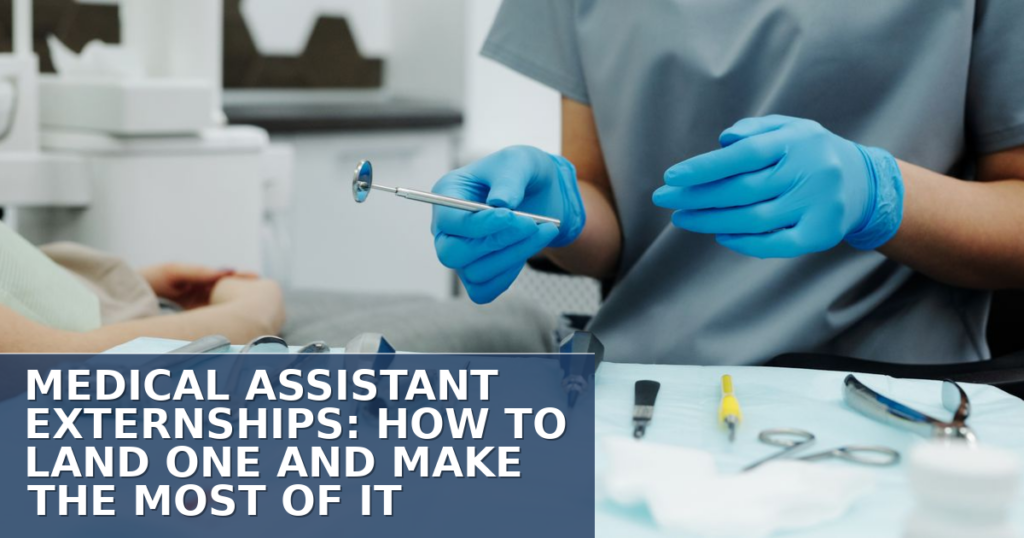
In a typical outpatient clinic, the answer to what does a medical assistant do usually starts with being the first clinical person a patient sees after check-in. MAs room patients, take vital signs like blood pressure and temperature, obtain a brief medical history, and often draw blood for labs. Depending on state scope-of-practice rules and the clinic, they may give injections, perform electrocardiograms (EKGs), assist with minor procedures, and provide patient education on medications or aftercare instructions. Clinical medical assistant duties and responsibilities also include updating the electronic health record (EHR), but that documentation is usually a secondary task built around direct patient care. For example, an MA in a vascular surgeon's office might remove sutures, do a Doppler pulse check, and then chart those findings before the physician enters the room.
What a Medical Scribe Does
A scribe's entire shift is built around documentation, not direct care. In an emergency department, a scribe shadows a physician from patient to patient, typing the history of present illness (HPI), review of systems, physical exam findings, and treatment plan into the EHR in real time. In an outpatient specialty clinic, a scribe may sit in the corner of the exam room with a laptop, capturing the physician's spoken exam notes and updating the chart so the provider can focus on the patient. The scribe does not independently room patients, take vitals, or perform any hands-on tasks. Some scribes later say the role gave them a front-row seat to medical decision-making, but they never physically touched a patient.
The Core Distinction in Practice
Both roles give you clinical exposure, but they exercise different muscles. A medical assistant learns how to interact with patients, recognize normal versus abnormal vital signs, and perform basic clinical procedures. A scribe learns how physicians think through differential diagnoses, structure a note, and navigate the pressures of clinical documentation. For med school applicants, both count as clinical experience in broadly accepted terms, but the MA role provides more unambiguous patient contact and hands-on skill development. The scribe role provides more direct observation of physician reasoning. If your goal is to prove you can handle patient-facing care before medical school, the MA role is the stronger, more tactile choice. If your goal is to absorb medical language and clinical decision-making from inside the exam room, scribing may be more efficient.
How Do Medical Assistants and Scribes Compare?
Does It Count? How AAMC and Med Schools View MA and Scribe Experience
Clinical experience, in the language medical school applications actually use, means direct patient contact or meaningful involvement in patient care, not simply working in a healthcare building.1 That distinction is the whole ballgame when you're deciding whether your job as a medical assistant or a medical scribe belongs in the clinical bucket on your AMCAS application.
AMCAS Draws a Real Line
AMCAS separates activities into distinct categories, and two matter most here: Paid Employment (Medical/Clinical) and Physician Shadowing/Clinical Observation.2 Shadowing is treated as its own thing, not interchangeable with clinical experience, because watching a physician work is passive: you're present, but you're not doing the care.1 AMCAS does not set one fixed number of hours you must hit before applying. What matters is that you can categorize your time accurately, list dates and hours, and describe what you actually did.2
This is where the underlying question (does this count as clinical experience?) becomes useful for MAs and scribes specifically. A medical assistant taking vitals, rooming patients, drawing blood, or giving injections is doing hands-on patient care through core medical assistant duties and responsibilities. That's clinical, full stop.1 A scribe sitting in on physician-patient encounters is a murkier case: valuable for clinical exposure, but if the job is purely transcription with no patient interaction, some advisors will tell you it leans closer to observation than active clinical experience.3
Paid Doesn't Mean Disqualified, and Duties Are What Count
A common misconception is that paid work can't be clinical experience. Not true. AMCAS explicitly separates Paid Employment (Medical/Clinical) from non-clinical paid work, so a paycheck doesn't push your MA or scribe job out of the clinical column.4 What decides the category is the nature of the duties and the medical assistant scope of practice, not whether you were compensated.4
Why Individual Schools Still Vary
AMCAS sets the framework, but admissions committees at individual schools apply their own judgment when reading your application.5 Some premed advisors recommend describing scribing carefully, emphasizing any direct patient interaction (rooming, vitals, communication) rather than just documentation, so the clinical value of the role reads clearly rather than getting lumped in with observation hours.3
Choose medical assistant if you want hands on patient care in your own two hands; choose scribe if you want a front row seat inside a physician's clinical reasoning.
The eMedical Assistants Editors
Medical Assistant Vs. Medical Scribe: Pay, Work Setting, and Benefits
How much more does a medical assistant make than a medical scribe, and where does each role actually work?
Pay and Setting at a Glance
Medical assistants generally earn more than medical scribes, but scribe pay shifts more with setting and shift type. Medical assistant salary tends to sit above the scribe ranges below, while medical scribe estimates cluster in the upper $30,000s to low $40,000s depending on the source.
Median hourly wage: Medical assistant median hourly pay runs above the scribe estimates below, while medical scribe estimates cluster around $16.55 to $18.72 per hour.
Typical annual salary: Medical assistants generally earn more on average, while scribe estimates land between roughly $37,989 and $41,129 depending on the source.
Common work settings: Medical assistants work in outpatient clinics, specialty practices, urgent care, and physician offices, though some pursue medical assistant hospital jobs in hospital-based clinics. Scribes work in emergency departments, primary care, specialty clinics, inpatient hospital units, and remote virtual scribe roles.
Certification or training required: Medical assistants usually complete a certificate or diploma program and may pursue CMA or RMA certification. Scribes typically train on the job with no national certification requirement.
Schedule flexibility or remote potential: Medical assistant roles usually follow clinic hours. Scribe roles can include evenings, weekends, hospital shifts, and virtual or remote schedules.
Where Scribe Pay Actually Lands
Because scribes are not a standalone BLS occupation, the ranges below reflect employer and job-board estimates in the Medical Scribe Career Guide rather than one official median. Emergency department scribes often start around $14 to $18 per hour and reach $20 to $25 with experience. Primary care tends to run lower at $12 to $16 entry and $18 to $22 experienced. Specialty clinics fall in the $13 to $17 entry range and $19 to $24 experienced. Virtual scribe roles typically pay $13 to $17 entry and $18 to $23 experienced, while hospital inpatient scribes can reach $20 to $26 per hour with experience.
Why the Tradeoff Matters
For pre-med students deciding between the two, the compensation difference is real but not the whole story. Medical assistant work tends to pay more consistently, and the medical assistant pros and cons include predictable clinic hours, but scribe roles may offer shifts that fit around classes, MCAT prep, or remote scheduling in ways a fixed clinic schedule cannot.
Medical Assistant Pay Across Major Metro Areas
Location moves medical assistant pay more than many pre-med students expect. Among the metros shown, San Francisco-Oakland-Fremont has the highest median annual wage at $59,910, while Detroit-Warren-Dearborn has the lowest at $38,370, a spread of roughly $21,500. Total employment also varies widely, from 45,710 medical assistants in the New York area down to 9,950 in Seattle.
Both roles can strengthen a pre-med application, but they build different strengths. Medical assistants gain direct patient contact and clinical skills, while scribes develop clinical reasoning through physician observation. Your best choice depends on what your application already has.
Pros
Direct patient care as a medical assistant gives you measurable clinical hours and hands-on skills like vital signs, injections, and rooming patients.
Medical assistants often run their own patient flow, which builds autonomy and confidence before medical school.
Scribing places you beside a physician for real-time clinical reasoning, documentation, and medical decision-making exposure.
Scribe work can strengthen your application with longitudinal physician mentorship and a strong letter of recommendation.
Cons
Medical assistant training and certification can take months and cost money before you earn any clinical hours.
Medical assistants may interact less with physicians on clinical decision-making, limiting some mentorship opportunities.
Scribes have minimal hands-on patient care, so you may need separate patient interaction hours to round out your application.
Scribe roles often pay less than medical assistant jobs, and the documentation-heavy workload can become repetitive.
Did you know that a medical assistant's paycheck depends heavily on geography? BLS Occupational Employment and Wage Statistics for 2024 show a gap of more than $15 per hour between the highest paying metro, San Jose, California, and the lowest, McAllen, Texas. Location can outweigh experience or specialty when comparing job offers.