Most important takeaways…
- Alaska leads all states with mean medical assistant pay near $49,000.
- Certified MAs earn roughly $6,000 more per year than non-certified peers.
- Experience and clinical duties can boost MA pay by 30% or more.
Compare medical assistant salaries across all 50 states, different experience levels, industries, and job duties to see where you can earn the most in 2026.
Medical assistants are the connective tissue of outpatient care, with nearly 800,000 employed and demand rising. Yet take-home pay can swing drastically, from barely $30,000 for a non-certified new hire in a low-cost state to nearly $60,000 for an experienced certified MA in a high-paying metro.
The gap hinges on a few concrete factors: geography, credentials, clinical duties, and industry. In a field where two people with the same job title can earn $15,000 apart, learning which levers matter most turns a tight labor market into a career you can move forward.
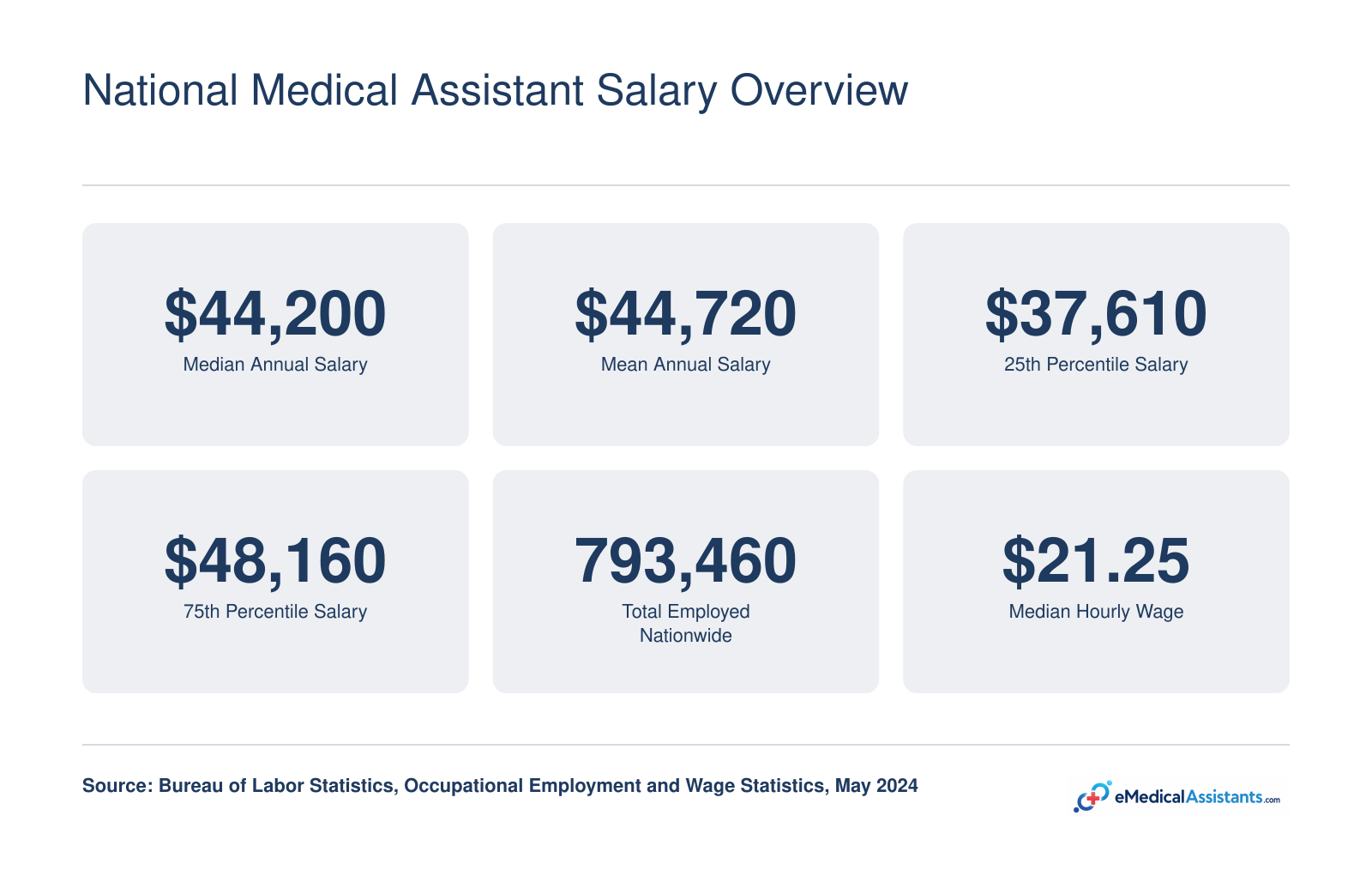
Here is a snapshot of what medical assistants earn nationwide based on the most recent federal wage data. With nearly 800,000 professionals employed, the field offers a stable job market. Actual 2026 earnings are projected to run slightly higher than these figures due to inflation adjustments since the data was collected.
The table below shows mean annual wages, 25th and 75th percentile pay, and total employment for medical assistants across selected states, based on the most recent Occupational Employment and Wage Statistics from the U.S. Bureau of Labor Statistics (2024 data). Alaska, Washington, and California rank as the three highest-paying states by mean annual wage, though each has a very different workforce size. Meanwhile, some lower-population states like Alaska and Vermont offer competitive pay partly because demand for healthcare workers outpaces local supply. Keep in mind that a high nominal salary does not always mean more purchasing power once cost of living is factored in.
| State | Total Employment | Mean Annual Wage | 25th Percentile | 75th Percentile |
|---|---|---|---|---|
| Alaska | 2,420 | $57,630 | $48,240 | $59,110 |
| Washington | 18,430 | $55,050 | $47,320 | $60,730 |
| California | 110,350 | $52,770 | $43,400 | $60,700 |
| District of Columbia | 2,530 | $52,880 | $46,720 | $56,460 |
| Oregon | 11,610 | $51,120 | $46,490 | $57,890 |
| Massachusetts | 16,210 | $50,390 | $45,610 | $55,320 |
| Minnesota | 9,930 | $50,190 | $46,270 | $55,080 |
| Hawaii | 3,830 | $50,030 | $44,870 | $55,640 |
| New York | 39,250 | $48,050 | $41,480 | $54,150 |
| New Hampshire | 2,990 | $47,770 | $43,920 | $50,930 |
| Colorado | 12,910 | $47,650 | $43,120 | $50,720 |
| Connecticut | 9,750 | $47,280 | $42,730 | $49,240 |
| Wisconsin | 12,900 | $47,230 | $43,460 | $50,010 |
| Maine | 4,120 | $46,940 | $42,390 | $49,990 |
| New Jersey | 22,530 | $46,000 | $38,820 | $49,100 |
| Vermont | 1,090 | $45,610 | $41,110 | $47,760 |
| Rhode Island | 3,270 | $45,670 | $42,780 | $47,380 |
| Maryland | 14,700 | $45,260 | $39,120 | $47,730 |
| Nebraska | 2,560 | $45,090 | $38,430 | $48,510 |
| Montana | 2,290 | $45,060 | $39,400 | $47,850 |
| Arizona | 23,300 | $45,010 | $39,740 | $48,140 |
| Illinois | 22,990 | $44,870 | $39,160 | $48,660 |
| Idaho | 5,090 | $43,600 | $37,870 | $47,870 |
| Iowa | 5,260 | $43,500 | $38,360 | $47,370 |
| Nevada | 7,440 | $42,740 | $38,060 | $46,250 |
Alaska consistently tops the list for medical assistant pay.
Tech hubs, coastal cities, and major healthcare corridors consistently pay medical assistants well above the national median. According to the Occupational Employment and Wage Statistics program (2024) from the U.S. Bureau of Labor Statistics, the metros below not only offer higher pay but also employ thousands of medical assistants, meaning job opportunities are plentiful alongside the bigger paychecks.
| Metro Area | Total Employment | 25th Percentile | Median Salary | 75th Percentile | Mean Salary |
|---|---|---|---|---|---|
| San Francisco, Oakland, Fremont (CA) | 15,130 | $49,070 | $59,910 | $75,330 | $62,560 |
| Seattle, Tacoma, Bellevue (WA) | 9,950 | $49,570 | $58,850 | $64,110 | $58,590 |
| Boston, Cambridge, Newton (MA, NH) | 12,290 | $46,350 | $49,150 | $58,040 | $51,370 |
| Chicago, Naperville, Elgin (IL, IN) | 18,130 | $40,460 | $46,740 | $49,980 | $46,130 |
| New York, Newark, Jersey City (NY, NJ) | 45,710 | $44,190 | $46,890 | $54,600 | $48,320 |
| Washington, Arlington, Alexandria (DC, VA, MD, WV) | 13,260 | $41,790 | $46,760 | $49,740 | $47,560 |
| Phoenix, Mesa, Chandler (AZ) | 17,230 | $41,060 | $46,090 | $48,560 | $45,920 |
| Los Angeles, Long Beach, Anaheim (CA) | 34,570 | $39,550 | $46,000 | $56,200 | $48,670 |
| Philadelphia, Camden, Wilmington (PA, NJ, DE, MD) | 12,650 | $40,140 | $45,830 | $47,800 | $45,730 |
| Atlanta, Sandy Springs, Roswell (GA) | 15,390 | $38,080 | $45,040 | $46,840 | $43,290 |
| Miami, Fort Lauderdale, West Palm Beach (FL) | 17,560 | $37,600 | $44,520 | $47,770 | $44,720 |
| Houston, Pasadena, The Woodlands (TX) | 16,580 | $37,160 | $42,930 | $47,550 | $42,050 |
| Riverside, San Bernardino, Ontario (CA) | 11,180 | $38,620 | $42,720 | $47,700 | $45,690 |
| Dallas, Fort Worth, Arlington (TX) | 21,110 | $36,300 | $40,160 | $46,460 | $41,590 |
| Detroit, Warren, Dearborn (MI) | 10,600 | $36,850 | $38,370 | $45,610 | $40,660 |
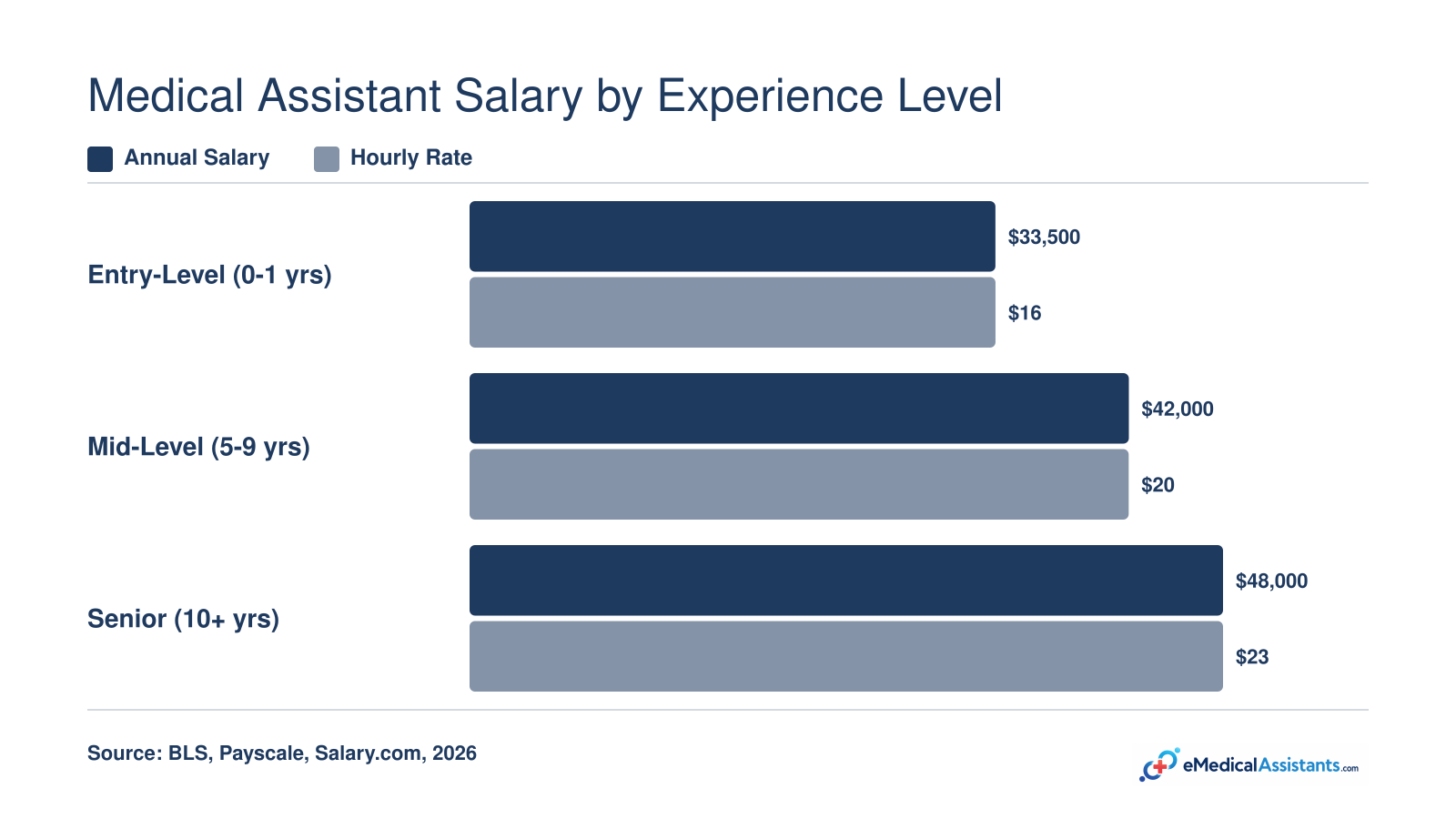
Your earning potential as a medical assistant grows meaningfully over time. Entry-level MAs typically start near the lower end of the pay scale, but with five to ten or more years on the job, hourly rates can climb 30% to 50% above starting wages. The figures below reflect approximate national averages drawn from industry salary surveys. Keep in mind that actual pay varies by state, employer, and certification status.
Where you clock in each day matters just as much as what you do. Medical assistants earn a median of about $42,000 a year nationally1, but the same skills can command noticeably different pay depending on the employer. The setting shapes everything: patient volume, specialized tasks, and the facility's own revenue streams.
More than 430,000 medical assistants work in physicians' offices, making it the single largest employer for the profession. The average wage in these private practices sits around $42,200.2 While you'll gain broad clinical and administrative experience, the pay tends to anchor near the national median because many smaller practices operate on tighter margins. If you're starting out, a doctor's office offers a steady entry point where you can build versatile skills quickly.
General medical and surgical hospitals employ roughly 115,000 medical assistants and pay an average of $45,760.2 That premium over physician offices comes partly from shift differentials, weekend rotations, and the complexity of inpatient work. Some hospital systems also offer richer benefits packages. In many metro areas, the gap can widen to 10-20% or more, especially for those in hospital medical assistant jobs where MAs float between departments or take on more technical tasks like phlebotomy and EKGs.
Outpatient care centers, including ambulatory surgery centers and specialty clinics, lead the pack with an average wage of $50,250.2 These facilities often handle higher-acuity patients and more specialized procedures, which translates into higher reimbursement rates and better pay for staff. MAs in cancer centers, dialysis clinics, and orthopedic surgery centers frequently report above-average earnings, and the pace can be faster but more predictable than hospital floors.
Industry surveys from MGMA and Indeed show that urgent care centers and telehealth platforms, among the Unusual Workplaces for MAs, are competing aggressively for medical assistants. While BLS doesn't break out these segments separately, job postings consistently list hourly rates that rival or exceed outpatient center averages. Telehealth roles, in particular, are growing fast and may offer remote or hybrid workflows alongside competitive pay. Surgical centers and corporate-run retail clinics are also high-growth areas worth watching if you want to maximize both income and career flexibility.
The duties you perform day to day have a direct, measurable impact on your paycheck. Medical assistants who handle clinical medical assistant duties consistently earn more than those whose work is limited to front-office or administrative support. The difference can be several dollars per hour, and it adds up quickly over the course of a year.
Employers place a premium on hands-on skills that expand a provider's capacity to see patients and bill for services. Self-reported pay data from Payscale and Indeed shows that each clinical skill you master can nudge your hourly wage upward.1
These increments stack. An MA comfortable with phlebotomy, EKGs, and injections often earns toward the upper end of the local pay scale without ever changing jobs.
When you demonstrate competence in multiple clinical areas, you become harder to replace and far more likely to be considered for roles with higher base pay. A 2026 wage analysis shows that medical assistants with specialized skills earn 14 to 22 percent more2 than their peers who perform only general administrative or basic clinical tasks. That premium widens when you add a formal certification: medical assistants with a certificate in medical assisting earn a median of $20.78 per hour, compared with $18.92 for non-certified teammates.2 Combine a credential with high-value skills like triage or procedural assistance, and your hourly rate can eclipse $23 or more in many markets.
Cross-training also opens doors to positions such as lead medical assistant, clinical team trainer, or specialty-practice MA. Those roles often come with salary bumps of $2 to $5 per hour3 over an entry-level, single-function MA because you are doing work that directly supports revenue-generating visits and procedures. The takeaway is straightforward: pick up a new clinical skill every six to twelve months, document it on your resume, and let your evolving job description pull your earnings upward.
Earning a nationally recognized credential is one of the most reliable ways to lift your medical assistant pay. While it is possible to work as a medical assistant without certification in some private practices, the salary data across multiple surveys consistently shows that certified medical assistants bring home noticeably higher wages.
Current 2026 national median figures paint a clear picture:
- Non-certified medical assistants: around $39,000 per year. - Certified MAs holding any major credential: typically between $42,000 and $44,000 annually. 3
The wage advantage for certified medical assistants generally falls between 10% and 25%, depending on the employer, the state, and the specific credential you hold. One large industry survey in 2024 reported an average premium of 22%1 for certified MAs over their non-certified peers, while the AAMA's own 2025 compensation report found a more conservative 4-6% premium2 for CMA (AAMA) holders specifically. In practice, the added earnings often sit in the middle of that range, with many certified MAs earning $3,000 to $5,000 more per year.
Not all certifications are viewed the same way by employers, and that can show up in your paycheck. Among the four most common credentials, 2026 median salaries break down like this:
- CMA (AAMA): $44,000 - RMA (AMT): $43,000 - CCMA (NHA): $43,000 - NCMA (NCCT): $42,000 3
The CMA (AAMA) credential often commands a slight edge, particularly in hospital networks and larger health systems that specifically request it. RMA and CCMA holders also see dependable increases, landing just behind the CMA in typical earnings. The NCMA credential still beats no certification at all, though its pay advantage tends to be a bit smaller. Across the board, any of these nationally accredited certifications will push your earning power above the non-certified baseline.
It's not just about the paycheck. Many employers now require or strongly prefer certification, especially hospitals, outpatient surgery centers, and large multi-specialty clinics. Certification signals that you've passed the certified medical assistant exam and have demonstrated competency in both clinical and administrative duties. In some states and facilities, holding a recognized credential can also expand your permitted job duties, such as performing certain point-of-care tests or handling medication administration under supervision.
Because certified MAs bring verified skills to the role, employers are often willing to pay for that reliability. If you're already working without certification, earning your CMA, RMA, CCMA, or NCMA can be the fastest route to a raise or a position at a higher-paying facility. And once you have it, meeting continuing education requirements to maintain your credential keeps you in the running for top-tier pay as your career progresses.
Did you know certification pays off fast? According to the AAMA's 2025 salary survey, Certified Medical Assistants earn about $3.00 more per hour than their non-certified peers working in physicians' offices, adding up to over $6,000 more annually for the same job duties.
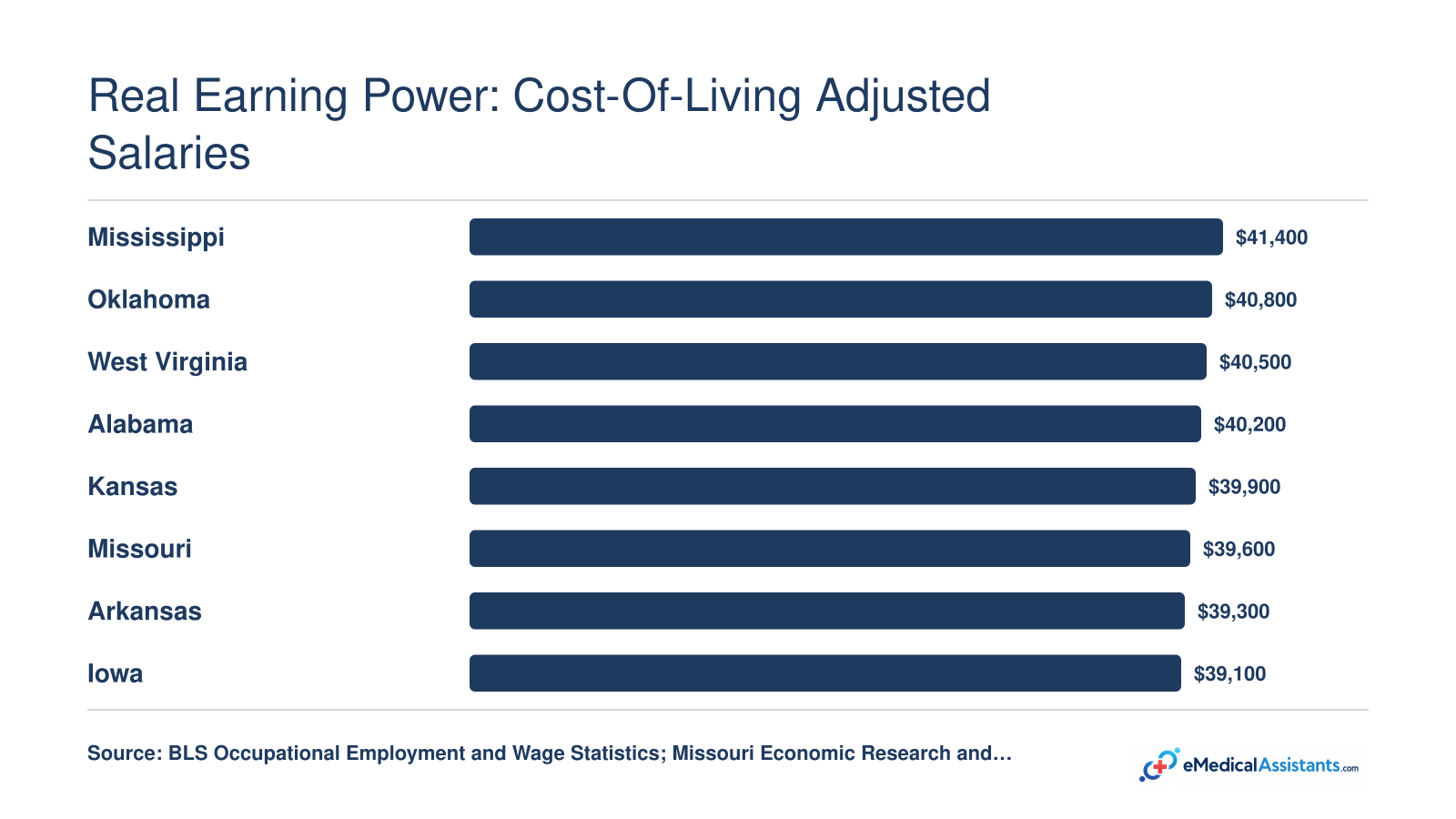
A high nominal salary doesn't always mean more money in your pocket. When you adjust BLS median wages by each state's cost-of-living index (where 100 equals the national average), states with lower living costs can deliver significantly more purchasing power than expensive coastal markets. For example, California's median medical assistant pay looks strong on paper, but its cost-of-living index well above 130 can erase that advantage. Meanwhile, states across the South and Midwest, with indices in the mid-80s to low 90s, stretch every dollar further. The top 10 states for real purchasing power in 2026 cluster in these two regions.
How much can your salary grow as you move from an entry-level medical assistant to a lead or specialized role? Understanding the typical timeline helps you plan your education, certifications, and job moves.
Start as a new medical assistant, often after completing a medical assisting course curriculum that typically lasts 9-12 months. Entry-level pay typically falls between $32,000 and $38,000 annually, depending on location.1 With 2-5 years of experience and strong clinical skills, you can step into a senior or lead MA role.2 This move often brings a 12% or larger wage bump,3 pushing salaries into the $48,000-$55,000 range.1
After 5-8 years in the field, you might qualify for a supervisory position such as clinical coordinator, back-office supervisor, or team lead. These roles carry more administrative responsibility, like scheduling, training, and quality checks, and often come with a corresponding increase. The total salary jump from entry-level to this stage can reach $10,000-$17,000 above your starting pay.1
Within 2-3 years of starting, some medical assistants choose to specialize in areas like podiatry, dermatology, or as an ophthalmic assistant.4 Specialized roles often pay a premium of $3,000-$8,000 per year on top of the typical lead MA salary.1 This path can run parallel to advancement up the supervisory ladder, giving you flexibility.
Adding credentials such as phlebotomy technician or EKG technician can fast-track your career. Employers value cross-skilled staff, and these certifications often justify a higher pay rate sooner, sometimes shortening the time to that first promotion.
Some medical assistants let their salary happen to them; others take deliberate steps to shape it. If you want your earnings to climb faster, a few focused moves can make a real difference, and the data throughout this guide backs each one up.
Getting certified lifts your pay, as we saw in the certified vs. non-certified comparison. But the biggest jumps come when you combine that credential with practical, billable skills like phlebotomy, EKG administration, or injection procedures. Employers pay more for MAs who handle a wider range of clinical tasks, and the job-duties section showed that clinical medical assistant roles with hands-on patient care responsibilities consistently out-earn front-office-only positions.
The industry breakdown revealed that outpatient care centers and hospitals often pay more than physician offices, especially for experienced MAs. If you're open to a change, target those settings first. When relocation is an option, go where the dollars stretch furthest. The state-by-state tables and metro-area rankings point you to top-paying regions, but don't forget to check the cost-of-living adjustments we covered, because a high nominal salary in an expensive city might leave you with less spending power.
Negotiating a raise or a job offer feels less daunting when you walk in with current data. Use the salary figures in this guide (by experience, setting, and location) to anchor your ask. Frame it around the value you bring: "Based on local market rates for MAs with my certification and three years of clinical experience, I'm targeting a range of X to Y." Combining certification with in-demand clinical skills remains the single most reliable way to advance your medical assistant career.
These are some of the most common questions prospective and working medical assistants ask about pay. Each answer is a quick summary of the data and insights covered in greater detail throughout this guide.