Should You Work as a Medical Assistant Before Med School?
A practitioner's honest take on clinical hours, costs, and how MA work stacks up for premed applicants.
By Jennifer GubblerReviewed by Editorial StaffUpdated September 7, 202610 min read
Most important takeaways…
Medical assistant work counts as hands-on clinical experience for medical school applications.
BLS projects 13 percent job growth for medical assistants through 2035.
Patient contact and training cost differ across MA, EMT, CNA, and scribe.
Medical assistants are projected to see 13% job growth from 2025 to 2035, but that demand does not make the role any less time-consuming for a premed student carrying a full science load. MA work and premed are complementary, not competing: the job supplies direct patient contact through clinical medical assistant duties, while the premed track protects the GPA and MCAT timeline that admissions committees still weigh heavily.
The real tradeoff is not whether the hours count, but whether you can log them without letting organic chemistry slip. Admissions officers value sustained clinical exposure over a rushed credential, which is why an MA role, often through part-time medical assistant programs, works best when it fits the edges of an academic calendar rather than swallowing it.
Medical Assistant vs Pre-Med: What's the Real Difference?
Search engines lump these two terms together constantly, but they are not competing paths. One is a paycheck. The other is a transcript.
Medical assistant is a job with medical assistant pros and cons. You get certified, you get hired, you take vitals, room patients, and draw blood for an hourly wage. Pre-med is not a job at all: it is a set of academic requirements (biology, chemistry, organic chemistry, physics, the MCAT) layered on top of whatever undergraduate major you choose. Nobody "applies" to be pre-med. You just take the courses and eventually apply to medical school.
Why the Confusion Happens
Both paths circle the same anxiety: how to get real clinical exposure before applying to medical school. Admissions committees want to see that applicants have spent meaningful time around patients, and MA work is one of the few entry-level jobs that puts you directly in exam rooms. So the terms get tangled in search because they are both answers to the same underlying question, not because they are interchangeable strategies.
Doing Both at Once
In practice, plenty of successful applicants run both tracks simultaneously. A common pattern looks like this:
Undergrad years: knock out prerequisite science courses while working part-time as a certified medical assistant, often 15 to 20 hours a week.
Gap year(s): work full-time as an MA after graduation while studying for the MCAT and finishing applications.
Combined result: a transcript that satisfies pre-med requirements plus a resume with real, paid clinical hours instead of unpaid shadowing.
What MA Work Doesn't Do
MA certification does not substitute for a single pre-med prerequisite. Chemistry is still chemistry. The MCAT still exists. What MA work does is supplement the application: it answers the "have you actually worked in healthcare" question that a 4.0 GPA alone cannot answer. Think of it as the clinical half of a two-part equation , a medical assistant career path, not a shortcut around the academic half.
Does MA Work Count as Clinical Experience for Medical School?
Clinical experience, in medical school admissions terms, means you directly provided hands-on care to patients rather than simply observing or handling paperwork. The AAMC draws a clear line between activities where you actively participate in patient care and those where you watch from the sidelines. Where medical assistant duties fall on that spectrum can shape how admissions committees view your application.1
What Qualifies as Patient Care Experience
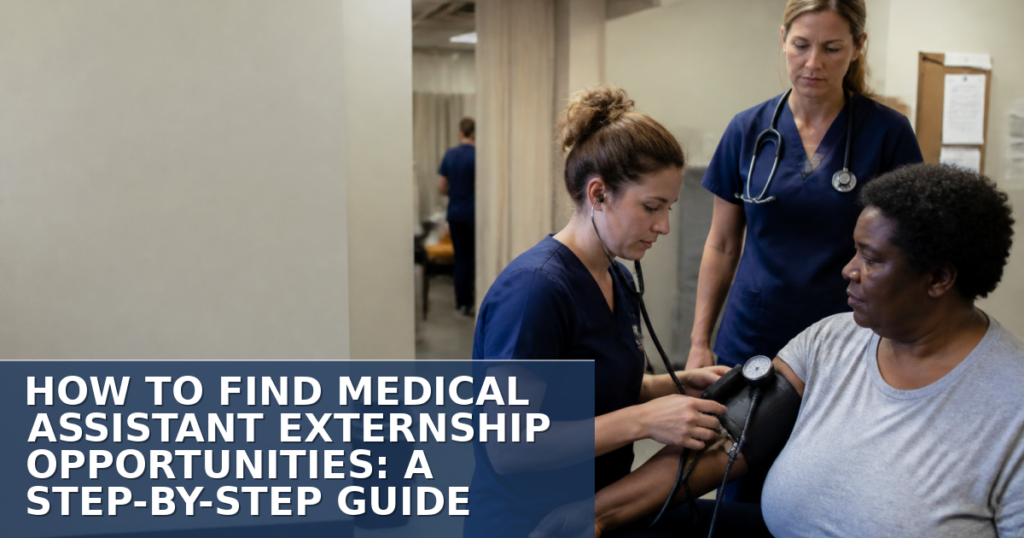
The AAMC considers roles like EMT and CNA as clinical experience because they involve direct patient contact and care delivery.2 Medical assistant work lands in the same category when your shifts include rooming patients, taking vitals, performing EKGs, or assisting with procedures.3 These tasks put you in a caregiving role where patients depend on your competence.
Front-desk scheduling, on the other hand, falls under administrative medical assistant duties and does not count as clinical experience even though you work in a healthcare setting.2 The distinction matters because admissions committees want to see that you understand what it feels like to be responsible for someone's wellbeing, not just that you showed up to a clinic.
Documentation Roles and the Gray Zone
MA positions that lean heavily toward charting, scribing, or administrative duties can blur the line, see the Medical Assistant vs Medical Scribe comparison for how those roles differ. If your day consists mostly of entering data into electronic health records while a physician examines patients, you may be functioning more as an observer than a caregiver. Log these hours carefully and honestly in your application. Describe exactly what you did rather than inflating passive observation into active care.4
Depth Over Hours
Admissions committees care more about the quality of your patient interactions than raw hour counts. There is no universal minimum, though some schools set specific thresholds.4 Augusta University's Medical College of Georgia, for example, expects at least 200 clinical hours.5 Other programs may expect more or less depending on their priorities.
If your MA role involves meaningful, repeated patient contact and direct clinical tasks, it generally counts as paid clinical experience.3 If you spend most of your time behind a computer screen, be prepared to explain how that role still exposed you to the realities of patient care.
How Many Clinical Hours Do You Really Need as an MA?
Medical Assistant vs EMT, CNA, and Scribe: Which Premed Job Wins?
Premed students often compare four common entry level roles: medical assistant, EMT, CNA, and medical scribe. The right choice depends on how quickly you need income, how much you can spend on training, and whether you want direct hands on patient care or physician observation. This table breaks down the practical differences.
Role
Training length
Upfront cost
Typical pay
Patient contact depth
Medical Assistant
9 to 18 months; many diploma or certificate programs run 9 to 12 months
$5,000 to $18,000 tuition
$44,200 median annual pay (2024)
Hands on clinical and administrative tasks: vital signs, preparing patients, drawing blood, giving injections where allowed, and assisting with minor procedures
EMT
1 to 4 months (120 to 150 hours)
$1,000 to $2,500 tuition; $1,400 to $3,200 total including exam, supplies, and background check
$41,340 median annual wage; about $20 per hour
Front line emergency care: assessing patients, performing basic life support, administering oxygen, controlling bleeding, and transporting patients
CNA
4 to 12 weeks
$500 to $2,000 average total cost to earn CNA license
$38,130 median annual pay; $18.33 per hour
Direct hands on care: bathing, dressing, feeding, toileting, transferring, taking vital signs, and assisting with activities of daily living under nurse supervision
Medical Scribe
On the job or short company run courses; no formal degree length program
No mandated certification; some employers use proprietary training programs whose costs are not standardized
Around $13 to $18 per hour; roughly $27,000 to $37,000 per year depending on hours worked
Primarily observes patient encounters and documents histories, exams, and orders; minimal direct hands on patient care
The Bureau of Labor Statistics projects 13 percent job growth for medical assistants from 2025 to 2035, much faster than the average for all occupations. That pace makes medical assistant work a reliably available clinical bridge, even if your long term goal is medical school rather than staying in the role.
Questions to Ask Yourself
How far out are you from submitting medical school applications?
If you have more than a year, you can complete MA certification and build substantial patient contact hours. If applications are sooner, a quicker option like scribing might fit your timeline better.
Would full-time MA work before undergrad push back your MCAT prep and prerequisite courses?
Working as an MA full-time means delayed coursework. Weigh whether the clinical depth you gain justifies adding a gap year or extending your pre-med timeline by a semester or more.
Does your target application cycle allow time to certify and log meaningful patient hours?
CMA certification takes roughly four to twelve months depending on your program. Factor in at least 500 to 1,000 hours of hands-on work afterward if you want experiences worth writing about in your application.
Do you crave steady, hands-on patient care, or would a flexible scribing role fit your semester schedule better?
MA shifts often run 30 to 40 hours weekly with set clinic schedules. Scribing typically offers more variable hours that can flex around exams and coursework.
Downsides and Limits of MA Work as Premed Prep
MA work is a practical way to get clinical exposure before medical school, but it is not a perfect substitute for every premed requirement. Weigh these tradeoffs against your timeline, finances, and the specific programs you plan to apply to.
Pros
Direct patient contact helps you test your interest in medicine early and gives you concrete examples for personal statements and interviews.
Many medical assistant programs are short and cheaper than a postbac, so you can start earning clinical hours without taking on heavy debt.
Working alongside physicians in a clinic can lead to strong, detailed recommendation letters that carry real weight.
Regular exposure to medical terminology, vital signs, and office workflows makes the first year of medical school feel less overwhelming.
You can apply what you learn in anatomy and physiology classes directly on the job, reinforcing your undergraduate science coursework.
Cons
Medical assistant work rarely involves research, and many medical schools still expect laboratory or clinical research experience on your application.
The pay is modest, and fitting MA shifts around undergraduate classes and MCAT prep can leave you with very little downtime.
Some admissions committees may view paid clinical work as useful but less academically impressive than research, leadership, or high level science coursework.
Depending on state scope of practice rules, your MA duties might be limited to front office tasks, which reduces hands-on clinical learning.
If you complete MA training before finishing premed prerequisites, you may delay your application timeline or face certification renewal costs.