Which Hospital Medical Assistant Skills Will Get You Hired in 2026?
Practical clinical, tech, and soft skills hospitals actually evaluate when hiring MAs.
By Jennifer GubblerReviewed by Editorial StaffUpdated August 17, 202618 min read
Most important takeaways…
Hospitals now expect Epic and Cerner charting fluency on day one.
Paid apprenticeships increasingly train medical assistants toward CMA certification while employed.
Phlebotomy, EKG, and telehealth support skills boost hospital job offers.
Clinic medical assisting and hospital medical assisting have diverged sharply by 2026. A clinic MA may room routine follow-ups and update charts. A hospital MA is more likely to draw labs on a med-surg floor, chart in Epic, and support a telehealth consult before noon.
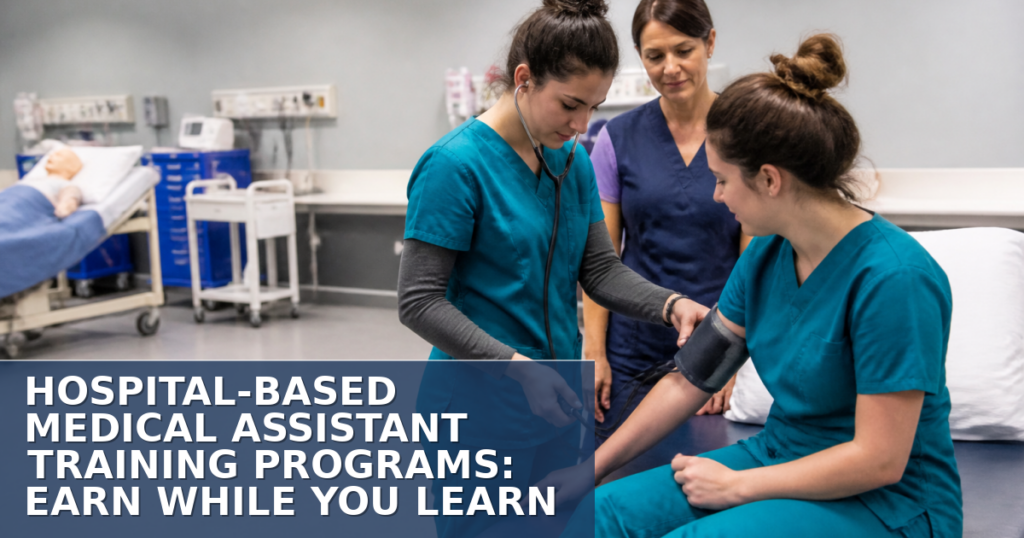
That shift means hospitals now interview for inpatient clinical skills, EHR fluency, and scope-of-practice judgment earlier than clinics do. UW Health in Madison runs paid medical assistant apprenticeships that train workers on the job and move them toward CMA certification, a model increasingly common at UW Health and other hospitals as staffing shortages deepen.
Why Hospital Medical Assisting Skills Differ From Clinic Roles
Hospital and clinic medical assistant roles share a core skill set, but the day-to-day pace and expectations differ. In a hospital, MAs are more likely to support higher-acuity patients, cross-cover units, and follow stricter documentation rules, while clinic roles center on longitudinal relationships and a more predictable panel. The comparison below highlights where hospital-ready skills diverge from typical ambulatory work.
Aspect
Hospital MA role
Clinic MA role
Phlebotomy and EKG use
Core hands-on skills include venipuncture, fingerstick phlebotomy, 12-lead EKG/ECG, and specimen collection, ready for higher-acuity patient monitoring.
Routine tasks include EKGs, venipuncture, ear lavage, and vision or hearing screens, often combined with front-office intake and scheduling.
Vital signs frequency
Vital signs are part of rooming and ongoing patient checks on busy units, with documentation aligned to institutional safety standards.
Vital signs are measured and documented at each visit to prepare patients for exams and keep providers on schedule.
Medication administration supervision
IM and SubQ injections, medication administration, and reconciliation occur under physician or RN supervision and follow hospital safety checks.
MAs prepare and administer medications and immunizations, with medication reconciliation tied to visit documentation and outpatient prescribing.
EHR ownership
Hybrid roles may manage check-in and check-out in the EHR, scheduling, and ICD coding, with documentation following organizational policies and legal limits for unlicensed personnel.
MAs update charts, reconcile medications, and queue orders for provider signature, while supporting scheduling and practice communications in the EHR.
Medication reconciliation
Explicitly listed alongside rooming, vital signs, phlebotomy, EKG, and injections, often as part of safety checks for higher-acuity patients.
Performed mainly during visit documentation and outpatient prescribing workflows, often as part of routine chart updates.
Patient communication
Works under relationship-based care models, participating as part of the healthcare team to meet patient and family needs.
Delivers an exceptional patient experience, explains procedures, answers questions, and provides telephonic support under RN or provider direction.
Scheduling and patient flow
May manage patient flow and scheduling at check-in or check-out while integrating into 24/7 unit operations such as transporting patients and stocking supplies.
Focuses on efficient outpatient flow: rooming patients promptly, keeping exam rooms clean and stocked, and scheduling diagnostic testing.
Telehealth support
Hospital job descriptions reviewed do not emphasize telehealth support, instead highlighting inpatient tasks like ADLs, transport, and supply stocking.
Clinic roles may provide telephonic support and MA-appropriate visits, such as vaccine administration and routine tests, under RN or provider direction.
Hospital Scope of Practice: What MAs Can and Cannot Do
State law and facility policy, not a national hospital rulebook, still decide what a medical assistant can do at the bedside in 2026.
Medical assistants are unlicensed assistive personnel. That means the permitted tasks depend on the delegating practitioner's authority, the assistant's documented training and competency, and the hospital's own protocols. Medical assistants generally cannot diagnose, interpret tests, prescribe, or treat independently, even in a hospital.
Why the same credential can mean different tasks
California: trained MAs may give intradermal, subcutaneous, or intramuscular injections with specific authorization and supervision by a physician, podiatrist, physician assistant, nurse practitioner, or nurse midwife.
New York: MAs cannot administer medications through any route, draw up syringes, or give vaccinations, contrast dyes, or injections. New York also bars triage and wound closure.
Rhode Island: oral, subcutaneous, and intramuscular meds are allowed, but controlled substances, IV injections, IV catheter placement, and arterial blood draws are not.
Supervision changes what a hospital will allow
Massachusetts and Maine require direct supervision for medication administration. New Hampshire requires physician delegation. Vermont requires only that the supervising provider be "reasonably available." Texas requires a physician, PA, or NP to be onsite for subcutaneous and IM injections, nebulizer treatments, and suture removal or dressing changes, but not for vital signs. This matters in hospitals because a floor may impose stricter rules than a clinic even when the state law allows a task.
Do not assume clinic duties transfer
Hospital employers often add competency checks before letting an MA perform venipuncture, EKGs, or medication tasks. Some states explicitly prohibit MAs from triage, wound closure, or IV-related work, so a skill learned in a clinic may not transfer. Ask for the facility's delegation protocol and competency checklist before claiming a skill. Keep written records of phlebotomy and EKG sign-offs, medication administration check-offs, and any state registration or licensure, because that documentation is what hiring managers use to confirm you are ready for the hospital's scope.
Core Clinical Skills Hospitals Expect on Day One
Core medical assistant clinical skills for hospital medical assistants in 2026 are not a fixed national list; they shift by employer, but a consistent set of expectations emerges: phlebotomy, EKG, vital signs, infection control, medication administration, and comfort with inpatient workflow.
Before relying on any single source, compare what current job postings are showing. On hospital career portals, Indeed, and LinkedIn, the same clinical skills show up repeatedly as required or strongly preferred qualifications. Search terms like "medical assistant phlebotomy EKG hospital" and note which tasks appear in the actual "required qualifications" section, not just the job summary. That front-line data is usually more current than a school brochure.
Where the baseline comes from
Use the BLS Occupational Outlook Handbook for Medical Assistants as a floor, not a ceiling. It lists standard clinical tasks: measuring vital signs, recording patient history, preparing patients for exams, and giving injections under supervision. Those remain expected. But hospital postings frequently add expanded medical assistant clinical duties such as phlebotomy, 12-lead EKGs, medication administration, and specimen collection.
Check competency documents, not just ads
The AAMA and AMT exam outlines are useful because they spell out the clinical competencies an entry-level MA should have. Review topics like infection control, patient preparation, medication administration routes, and lab procedures. If a task appears prominently on the exam outline and consistently in local hospital postings, it is a reasonable day-one expectation.
Use your program checklist as a gap analysis
Compare your training program's clinical skills checklist with hospital job requirements. Schools often update checklists based on employer feedback. If your program does not include EKG or phlebotomy practice, that is a signal to pursue a short specialty certification or a medical assistant externship before applying to an inpatient unit.
On certification, the trend matters. Employer surveys, while not hospital-only, show certification is a near-default expectation: 78% of employers required certification in 20241, 70% required it in a 2025 follow-up2, and 87% required or preferred it based on 2023-2024 data3. None of those figures isolate hospitals, but hospital systems tend to standardize on the same required or preferred language.
Hospital-ready does not mean mastering one clinic task. It means you can move across units, follow hospital protocols, and work under supervision when a patient's condition changes quickly. Hospitals value adaptability, safe judgment, and comfort with a wider scope of care more than a single specialized skill.
Administrative and EHR Skills That Keep a Hospital Floor Moving
Epic and Cerner charting skills have become a baseline expectation in 2026 hospital medical assistant postings, not a differentiator. On an inpatient unit, documentation has to be concise but complete enough for the next shift to act on.
Inpatient Documentation: Concise, Timed, Complete
A hospital medical assistant in Epic or Cerner typically documents chief complaints, vital signs, medical histories, current medications, problem lists, and family or social history. Chart prep matters too: reviewing charts before visits, scanning outside records, and updating the EMR entry so the care team is not hunting for information. When a vital sign is abnormal, the most useful note includes the reading, the time, and who was notified. In many inpatient settings, intake and output (I&O) entries and discharge documentation tasks are also expected. The term ADT (admission, discharge, transfer) describes patient movement through the unit, and MAs may update or verify relevant fields as part of that flow.
Order Support and Medication Reconciliation
Medical assistants do not independently place every inpatient order, but they often support order entry, order reconciliation, and medication reconciliation in Epic depending on their training and the hospital's policy. A 2025 Epic update made admission order reconciliation more visible by displaying home medications alongside hospital orders, which is exactly the kind of workflow MAs may help keep organized. Accuracy here matters because medication reconciliation errors are a known contributor to readmissions. MAs may assist with order sets and verify that the MAR (medication administration record) reflects current orders.
In-Basket and Task Queue Management
Hospital clinics and hospital-affiliated practices increasingly ask MAs to manage Epic in-basket messages. That includes shared pools for refill requests, patient medical advice requests, telephone encounters, results triage, and prior authorizations. Credenza medical assistant job posts, for example, mention checking Epic in-basket routinely. Epic Health posts ask MAs to coordinate follow-up appointments. Keeping those queues moving prevents tasks from stalling until the next shift.
Care transitions are where these skills connect: when a patient moves from the emergency department to a floor or from the hospital to home, clean charting, reconciled meds, and cleared in-basket tasks reduce the risk of something falling through.
Tech and Telehealth Skills That Are Becoming Non-Negotiable
Hospitals are no longer treating telehealth support as optional; they are screening for medical assistants who can room a patient virtually, troubleshoot home devices, and coach someone through a portal before the visit starts. The exact split of these medical assistant duties and responsibilities varies by floor and staffing model, but the core expectations are consistent across virtual and hybrid hospital practices.
Virtual rooming is now a real clinical task
Telehealth rooming often follows a seven-part rhythm, as explained in How Medical Assistants Support Modern Telehealth. Before the visit, the MA confirms the patient's identity, checks that audio and video work, verifies the patient is in a private setting, and documents that HIPAA was assured. The MA then collects home vital signs such as blood pressure, temperature, or weight if the patient has a home device, reconciles medications, records the chief complaint and relevant history, and sets a brief agenda. When a device will not connect or a vital sign looks abnormal, the MA escalates that issue rather than trying to fix everything alone.
Remote monitoring and wearables need both setup and follow-through
Hospitals are assigning MAs to help patients use blood pressure cuffs, pulse oximeters, and glucometers at home.1 That includes teaching proper use, checking that readings transmit into the patient's chart, and routing anything outside expected ranges for clinician review. Wearable setup is not just technical; it requires explaining what the patient should do each day and what the data will and will not show.
Portal messaging and digital check-in are part of the job
Digital check-in includes verifying identifiers, confirming who is present for the visit, and assessing privacy before the clinician joins, a pattern highlighted in the Safety-Net Telemedicine Study. Afterward, MAs may route secure messages, schedule follow-ups, coordinate labs or referrals, and explain post-visit instructions through the patient portal. That means writing clear, plain-language instructions is as important as knowing the software.
The common thread is patient coaching. A medical assistant who can guide a nervous patient through a video visit or a first-time remote monitor setup is more useful than one who only knows how to click the right buttons.
Apprentices typically receive on-the-job training and may work toward certification, such as the Certified Medical Assistant (CMA) credential, while employed.
Cap Times reporting on hospital medical assistant apprenticeships
Soft Skills That Hospital Hiring Managers Actually Evaluate
Hospital hiring managers do not treat soft skills as a vague personality check. They evaluate them through behavioral interview questions for medical assistants and scenario-based follow-ups, and the strongest candidates tie every answer back to patient safety and team flow.
Behavioral Questions Are the Real Test
There is no national scoring rubric for medical assistant soft skills, but hiring panels consistently look for the same pattern: communication, calm under pressure, attention to detail, and respectful patient interaction. Expect questions about:
Upset patients: How do you de-escalate someone who is anxious or frustrated?
Multiple tasks: How do you prioritize when several patients need help at once?
Error catching: Tell me about a time you noticed a mistake in documentation or orders.
Difficult coworkers: How do you handle friction without delaying care?
Safety escalation: When would you stop and get a nurse or provider?2
Use the medical assistant STAR method interview format to answer.2 Describing the situation, task, action, and result keeps your response concrete and shows you understand the hospital's workflow.
Scenario Responses That Score Well
A hospital interviewer may ask you to walk through catching a medication list discrepancy. A low-scoring answer says, "I would just enter what the patient says." A high-scoring answer describes pausing to confirm each medication, comparing the electronic health record, and alerting the nurse before the provider sees the patient. That answer shows attention to detail, clear communication, and escalation, not just compliance.
Questions about codes or rapid responses are not looking for heroics. They are checking whether you can recognize urgency, stay calm, communicate clearly, and escalate appropriately.3
A strong cultural competence answer is not about reciting terms. It describes adjusting your communication style to the patient's needs, using plain language, and confirming understanding without interrupting.
Where Safety and Satisfaction Meet
Hospital managers connect these behaviors to concrete goals. De-escalation reduces falls and helps keep patients calm. Accurate handoffs reduce medication errors. Consistent infection control habits and respectful, inclusive communication improve patient satisfaction scores and reduce complaints. When you explain your soft skills in those terms, you show hiring managers that you understand why the skills matter on a hospital floor.
Specialty Certifications and Credentialing That Boost a Hospital Application
For hospital applications, a well-chosen credential stack can signal readiness for inpatient workflows. The table below compares six common credentials and the specific hospital skills each one supports. Use it to decide where to focus your next certification step.
Credential
Awarding Body
Hospital Skill It Demonstrates
Typical Eligibility
CMA (AAMA)
American Association of Medical Assistants (AAMA)
Demonstrates competence in general, administrative, and clinical duties including infection control, patient intake and vitals, phlebotomy and specimen handling, EKG, pharmacology and medication administration, and assisting with exams and minor procedures, aligning with hospital medical assistant workflows.
Requires graduation from or current enrollment as a recent student in a medical assisting program accredited by CAAHEP or ABHES.
RMA (AMT)
American Medical Technologists (AMT)
Demonstrates competence in core medical assisting functions: clinical tasks, basic laboratory procedures, and administrative responsibilities relevant to hospital outpatient clinics and procedural areas.
Requires prior certification through AMT and disclosure of any felony conviction for recertification by exam; initial RMA eligibility generally includes graduation from an approved medical assisting program or sufficient work experience in medical assisting.
CCMA (NHA)
National Healthcareer Association (NHA)
Demonstrates competence in clinical patient care (84 exam questions), anatomy and physiology, foundational science, patient care coordination and education, administrative assisting, communication and customer service, and medical law and ethics, skills used in hospital clinics and ambulatory care.
Requires a high school diploma or GED plus either completion of a medical assistant training or education program within the last 5 years or 1 year of supervised work experience in a medical assisting field within the last 3 years or 2 years within the last 5 years.
NHA Certified Phlebotomy Technician (CPT)
National Healthcareer Association (NHA)
Demonstrates competency in venipuncture and capillary blood collection, specimen handling, and adherence to phlebotomy procedure counts, key skills for hospital laboratory and inpatient draw teams.
Requires a high school diploma or equivalent plus completion of a training program within 5 years of the exam or meeting NHA work experience requirements, and documented completion of 30 venipunctures and 10 capillary or finger sticks.
EKG Technician Certification (NHA)
National Healthcareer Association (NHA)
Demonstrates competence in performing and assisting with EKG procedures, clinical patient care tasks, and basic cardiovascular monitoring used in hospital telemetry, ED, and cardiology units.
Typically requires a high school diploma or GED plus completion of an EKG or patient care training program or supervised experience; NHA exam pathways mirror CCMA-style requirements of recent education or supervised work in the field.
BLS Provider (AHA)
American Heart Association (AHA)
Demonstrates competence in recognizing cardiopulmonary arrest, performing high-quality CPR, using an AED, and responding as part of a resuscitation team, core emergency skills required for hospital clinical staff.
Requires enrollment in an AHA BLS provider course; for renewal or update courses, the student must hold a current, valid AHA provider certification eCard on the day the update course is taught.
The Pay Signal Behind These Skills
In hospitals, the right skill mix is often rewarded with higher pay.
How to Show Hospital-Ready Skills on Your Résumé and in Interviews
How do you prove you can handle a hospital floor before you have hospital floor experience? Hospital hiring managers do not need another medical assistant resume that says "EKG experience." They need evidence you can perform under med-surg volume.
Turn Clinical Skills Into Measurable Lines
Replace generic phrases with scope and frequency. For example, instead of "EKG experience," write "Performed and routed 30+ EKGs weekly on a 36-bed med-surg unit." Instead of "knowledge of medical terminology," say "Translated discharge instructions and medication changes for 15+ patients per shift." If you have phlebotomy or point-of-care testing, name the volume and setting.
Put Certifications Next to the Work
Do not bury your Certified Clinical Medical Assistant, phlebotomy, or EKG credentials in a separate block only. Add them to the exact line where they apply. A bullet reads stronger as "Drew 25+ labs per shift as a certified phlebotomy technician" than as two disconnected fields. Hiring managers scan quickly, and this placement signals the certification is active, not decorative.
Bring Three Hospital-Specific STAR Stories
Before the interview, prepare three short stories using Situation, Task, Action, Result. Choose moments that mirror hospital medical assistant duties:
- A medication reconciliation catch that prevented a duplicate or incorrect dose.
- An EHR task queue triage where you prioritized stat orders, prior authorizations, or abnormal flags.
- A telehealth visit rescue where you troubleshot patient tech issues or kept a visit on schedule.
Keep each story under 90 seconds. Hospital interviewers often probe for clinical judgment under time pressure.
Ask About Orientation Competencies
At the end, ask: "Which EHR and telehealth platform will I be using, and what competencies are checked at orientation?" This does two things. It shows you are already thinking in hospital workflow terms, and it gives you a checklist for what to review before day one.