Most important takeaways…
- May 2024 data show 1,070 medical assistant jobs in the Florence metro.
- Florence metro medical assistants earn a median $36,330 per year.
- CAAHEP or ABHES accreditation protects exam eligibility and employer trust.
Compare accredited programs, costs, and externship options within commuting distance of Florence.
A medical assistant in Florence handles vitals, patient intake, EKGs, and basic lab draws for physicians at systems like McLeod Health, MUSC Health Florence, and HopeHealth, all of which staff outpatient clinics across the Pee Dee region and post entry-level MA openings on a rolling basis. That steady clinical demand is why training options here range from a six-month certificate to a two-year associate degree, with tuition and job-readiness varying sharply between them.
Most Florence-area students end up choosing between a handful of small private training centers, Florence-Darlington Technical College's program, or an accredited online/hybrid track that ships clinicals to a local site. Cost, accreditation status, and how fast you can sit for a national certification exam are the real variables worth weighing.
You can work as a medical assistant without certification to get started, but a CMA or RMA credential changes how Florence employers read your resume. South Carolina does not require a state medical assistant license or a single statewide certification to accept most medical assisting jobs.1 In practice, though, the hiring standards around Florence are set by the region's major systems, and those systems want more than a short course sticker.
Florence pulls patients from a wide I-95 and I-20 corridor. McLeod Regional Medical Center is the largest local anchor, and MUSC Health Florence, formerly Carolinas Hospital, adds another major hospital system. HopeHealth and other community health centers serve primary care and safety-net needs, while private physician practices cluster near the hospitals and along the interstate exits. For students comparing best medical assistant schools in south carolina, clinical rotations and first jobs are often concentrated around those same campuses rather than scattered evenly across town.
Within a 60 to 90 minute drive, Darlington, Hartsville, Lake City, Sumter, and Myrtle Beach add more ambulatory clinics, specialty offices, and coastal healthcare employers. Some students commute toward Myrtle Beach for expanded options; others stay in the Pee Dee and find stable openings closer to home.
State law is more nuanced than many career pages suggest. South Carolina does not require every medical assistant to carry a license. A 2024 law set requirements for Certified Medical Assistants, and the clearest state guidance points to CMA certification for clinical duties after July 15, 2026.1 Those who do not meet the CMA path may be treated as unlicensed assistive personnel2, which can reduce the scope of clinical tasks and increase supervision. For students, the benefits of medical assistant certification make certification a practical employment step even though the state does not operate a separate MA license.
Most Florence-area employers list CMA (AAMA) or RMA (AMT) credentials as preferred or required for clinical roles, especially hospital systems. A few private practices may train on the job, but the strongest postings lean credentialed.
One common point of confusion in the Florence market involves the differences between CNA and medical assistant. CNA programs focus on direct patient care and often prepare students for a state nurse aide registry. Medical assistant training blends clinical duties, such as rooming patients and taking vital signs, with administrative work like scheduling and electronic health records. If a Florence program advertises only basic patient care hours and no medical assisting credential path, it is probably not a full medical assistant program.
Florence has real medical assistant training programs, but the local search results mix them with CNA-only and phlebotomy-only schools more often than students expect. If you want to sit for a medical assistant credential, confirm that the school actually teaches clinical and administrative medical assisting, not just nursing assistant skills.
Among frequently searched private schools, Professional Medical Training Center, often called PMTC, has the clearest medical assistant offering. PMTC's Clinical Medical Assistant program is a 6-month certificate track that prepares students for the National Healthcareer Association CCMA exam.12 The school also lists a separate Medical Administrative Assistant certificate, so PMTC is not a CNA-only center.
Revived Medical Training Academy also lists Medical Assistant and Medical Administrative Assistant among upcoming classes.3 Its program lineup is broader than CNA, but class availability can change. Ask which start dates are actually open before you apply.
Johnson-Thomas Medical Training, PeeDee Medical Career Training, and Mejias Medical Career Training appear in local searches, but current public listings do not clearly confirm dedicated medical assistant diplomas or certificates at those schools. Some may focus on CNA, phlebotomy, or other allied health tracks. Treat those as call-and-verify options rather than confirmed MA programs.
Florence-Darlington Technical College does offer a dedicated Medical Assisting program, housed under its Nursing and Allied Health division. It is a Diploma in Applied Science that takes about 15 months and requires 44 credits.4 That is a college-based path, not a short certificate, and it gives you a more structured health science base alongside the medical assisting coursework.
You will see two realistic timeframes in Florence. A private certificate may run about 6 months, as PMTC advertises. FDTC's diploma is 15 months. Associate degree paths, if you continue beyond a diploma, generally take 18 to 24 months depending on transfer credits and general education requirements.
Before paying a deposit, ask four questions:
The gap between state-approved and programmatically accredited medical assistant programs is one of the most consequential details prospective students overlook, and in the Florence area it deserves extra attention. Understanding three tiers of program oversight will help you protect your investment and keep your certification options open.
Not all "accredited" labels carry the same weight. Here is what each tier actually means for you:
As of mid-2026, no medical assistant program physically located in the Florence area appears in either the CAAHEP or the ABHES online directory. Local training providers such as PMTC and Revived Medical Training Academy offer medical assistant coursework, but neither holds programmatic accreditation from CAAHEP or ABHES based on current directory listings. That means graduates of those programs would not be eligible for the CMA (AAMA) exam.
The nearest CAAHEP-accredited options in South Carolina include Central Carolina Technical College in Sumter (roughly 60 miles from Florence), along with schools farther afield like Aiken Technical College, Midlands Technical College in Columbia, and several others around the state.
Your program's accreditation status directly controls which national certification exams you can take after graduation:
If earning the CMA is your goal, and it should be high on your list given employer preferences, you need a program with CAAHEP or ABHES accreditation. A state-only license will not get you there.
Do not rely on a school's marketing materials alone. Before you commit tuition money, look up the program yourself in the CAAHEP directory and the ABHES directory. Both are free and searchable by state. If the program does not appear, it is not programmatically accredited, regardless of what a recruiter may imply. Taking ten minutes to verify could save you from completing a program that limits your career options from day one.
Only a handful of in-person Medical Assistant programs sit within a reasonable drive of Florence, which is why online medical assistant programs for working adults and hybrid options from accredited schools have become the default choice for a growing share of local students. If your commute to Florence-Darlington Technical College or a Sumter-area campus doesn't line up with your work schedule, a hybrid program can fill the gap without forcing you to quit your job.
Most hybrid MA programs split the training into two tracks. The medical assisting course curriculum (medical terminology, anatomy, pharmacology basics, insurance and billing, medical law and ethics) runs asynchronously online, usually through a learning management system with weekly deadlines. The hands-on portion, drawing blood, taking vitals, running EKGs, injections, sterile technique, has to happen in person. Some programs bring students to a regional skills lab for weekend intensives; others contract with local clinics to host lab days.
Every accredited MA program requires an unpaid medical assistant externship, typically 160 to 200 hours. This is where online students need to ask hard questions before enrolling. Some national online programs maintain clinical affiliation agreements and will place you at a Florence-area practice. Others hand you a checklist and expect you to self-arrange a site, which can be a real obstacle if you don't already have healthcare contacts. Call the admissions office and ask directly: do you place students at sites near ZIP 29501, or do I find my own?
For MAs already working front-desk or CNA shifts at McLeod Regional Medical Center or MUSC Health Florence, evening cohorts and Saturday lab days are the deciding factor. Not every program offers them, so confirm the actual class calendar before you commit.
Medical assistant training in the Florence area usually blends two skill tracks. On the administrative side, students learn appointment scheduling, patient intake, insurance verification, basic billing and coding, and how to work inside an electronic health record. On the clinical side, programs teach vital signs, phlebotomy, injections, EKGs, specimen collection, and infection control. Strong programs do not treat one track as an afterthought. Students should leave prepared to handle both the front-office workflow and direct patient care tasks that Florence-area employers expect from a new medical assistant.
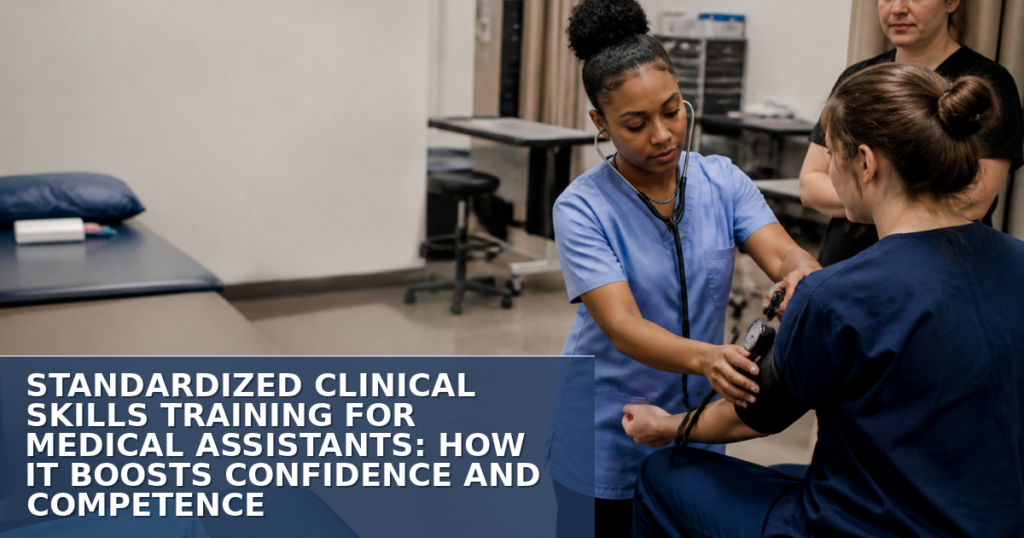
Lab time is where clinical skills become real. In a quality program, students practice blood draws on mannequins and peers, perform injections with saline, apply EKG leads, and review proper body mechanics and safety procedures before entering a clinical site. Online coursework can handle terminology and medical office concepts, but an online-only program without an in-person lab component cannot realistically prepare someone to perform phlebotomy, give injections, or capture a clean EKG. If you are comparing programs in Florence, ask how many scheduled lab hours are included and whether those labs happen on campus or at a partner site within commuting distance.
Externship hour requirements vary by school. South Carolina School of Phlebotomy lists a clinical placement of 40 to 120 hours, while Herzing University and Florence-Darlington Technical College require about 180 clinical hours. During the externship, students work under supervision in real clinical environments. Common tasks include rooming patients, taking histories, checking vital signs, assisting with minor procedures, documenting in the EHR, and handling front-office duties between patient visits.
Placement support also differs. Some programs, such as South Carolina School of Phlebotomy, have an externship coordinator assign the site and date with a partner facility. Others, like Herzing, may offer help from a clinical coordinator but still require the student to locate and secure the preceptor and site. A few self-paced or online-focused options operate as self-managed externships, meaning the school does not place, arrange, or supervise the experience. Before enrolling, ask exactly how placement works and what backup support exists if a site falls through.
Florence-area students commonly complete externships in physician offices, urgent care centers, community health centers, and hospital outpatient departments. The MUSC Health regional network in Florence appears in local extern listings, and students may find opportunities in Florence, Darlington, and Hartsville depending on current availability. Programs do not always publish a full list of active sites, so ask for recent placement examples and whether the school has existing relationships with local clinics or hospital departments.
South Carolina does not require a state license to work as a medical assistant, but employers in the Florence area strongly prefer certified candidates. The typical path takes about 6 to 24 months depending on certificate or associate route.

Medical assistant training costs in the Florence area vary far more than tuition stickers suggest, and the students who get the best deal are usually the ones who compare the full bill before enrolling.
According to the most recent federal college scorecard data, the institution-wide average net price after grant aid for the community and technical colleges serving Florence-area students runs from about $2,892 at Robeson Community College to $9,148 at Southeastern Community College. Horry-Georgetown Technical College sits around $4,159, Richmond Community College around $5,071, and Northeastern Technical College around $6,913. These are school-wide averages, not promises for a specific medical assistant program. A program page can list a different figure before aid. For example, Horry-Georgetown's clinical medical assistant program lists estimated tuition around $6,778 for in-state students and $10,978 for out-of-state students, which is higher than the college-wide average after aid.
Private medical assistant trade schools in the Florence area often publish certificate prices in the $5,000 to $15,000 range. Community and technical colleges with accredited medical assistant programs can come in lower for in-state students, but the financing options are not the same everywhere. Online medical assistant programs and hybrid options can land somewhere between the two, often with lower facility fees but separate technology or proctoring costs.
Some private training centers are not Title IV eligible, which means students cannot use federal Pell Grants, federal student loans, or federal work-study to cover tuition at those schools. One signal to check is whether a school routinely enrolls federal aid recipients. At Horry-Georgetown Technical College, roughly 79% of undergraduates receive Pell Grants, so federal aid is a normal part of the student funding mix there. If a school does not participate in Title IV programs, you will likely be looking at out-of-pocket payments, private loans, or institutional payment plans.
Do not compare programs by tuition alone. Ask for a written total program cost that includes: - Tuition and required fees - Books, online access codes, and lab supplies - Uniforms, shoes, and a basic clinical kit such as a stethoscope and blood pressure cuff - Background check, drug screen, and immunization or titer costs - CPR certification and any required health documentation - Certification exam fees and prep materials - Travel or parking costs for clinical externships
Have the school confirm whether the stated price is the complete program total or just the first term, and ask which costs are refundable if you withdraw.
You finish your program with two realistic paths: sit for a national certification exam right away, or start applying with just your diploma and hope employers overlook the missing credential. In the Florence market, the first path is almost always the right one.
The CMA exam runs about $250 for AAMA members (higher for non-members), is computer-based, and covers three broad domains: general (psychology, communication, law and ethics), administrative (scheduling, billing basics, records), and clinical (patient prep, phlebotomy, pharmacology, emergencies). RMA and NCMA exams cost roughly $120 to $180 and cover similar territory with slightly different weighting.
Florence Darlington Technical College and other regional programs typically build a capstone review course into the final term, plus practice exams through platforms like AAMA's online question bank or third-party medical assistant CMA exam prep tools. Shorter certificate programs vary more, some include structured review, others expect you to self-study using books like the Kinn's Medical Assistant text.
South Carolina does not legally require MA certification to work. In practice, McLeod Health, MUSC Health Florence, and most multi-provider practices in the Pee Dee region treat it as the hiring standard, which makes medical assistant certification worth it for new graduates. Uncertified applicants get filtered out early, so plan to test within 90 days of graduation while the material is fresh.
May 2024 federal data show 1,070 medical assistant jobs in the Florence, SC metro area and a median annual wage of $36,330 ($17.47 per hour). For context, the national median was $44,200 per year, while an often-cited South Carolina statewide median is $38,820 per year, a figure that should be treated as approximate. The Florence 10th and 90th percentile annual wages were roughly $29,470 and $44,390, and program-level graduate earnings were not available in the data reviewed. No metro-level job growth projection was available in the source data for this snapshot.
| Metric | Florence, SC MSA | South Carolina (approx.) | United States |
|---|---|---|---|
| Median annual wage | $36,330 | $38,820 | $44,200 |
| Median hourly wage | $17.47 | $19.00 | $21.25 |
CAAHEP and ABHES accreditation typically satisfies CMA or RMA exam eligibility, but some exams have separate pathways. Choosing a program that does not align with your intended certification can delay or limit your options.
Travel to another city adds time and gas costs. Clinical site assignments can change, so confirm where recent students completed externships before enrolling to avoid a commute that disrupts your schedule.
Many Florence students work while training. A program with only daytime labs may conflict with a full-time job, while evening, weekend, or hybrid formats can offer the flexibility you need to stay enrolled.
Tuition alone can understate expenses by several hundred dollars. Itemizing exam fees, uniforms, books, and background checks gives a more accurate cost comparison across Florence programs and helps you budget realistically.
What do I actually need to have ready before I can start a medical assistant program in Florence, SC? The safest baseline is a high school diploma or GED, but the rest of the checklist can look different depending on whether you are applying to a private training center, a workforce course, or an accredited community college program.
Many programs ask for some combination of the following:
Private training centers and shorter workforce courses tend to be more flexible, often using rolling enrollment or course-by-course registration. The Revived Medical Training Academy admissions page in Florence lists a high school diploma or GED, age 18 or older, a background check, drug screen, and negative TB test. Florence-Darlington Technical College's continuing and workforce registration page also points toward course-by-course signup for some courses rather than a standard college application, so it is worth confirming the current medical assisting enrollment process directly.
Accredited community college programs can be more structured. Midlands Technical College, for example, lists a high school diploma or equivalent, First Aid and CPR, an interview, and acceptable background check and drug screen at program entry.1 Southern Regional Technical College adds age 18 or older, AHA BLS, First Aid, a physical exam, current immunizations, criminal background check, and TB screening.2
Do not wait until the last minute to start your paperwork. Immunizations may require multiple visits spaced weeks apart, and background checks or drug screens can take time to process. For programs with fixed application windows, such as Trident Technical College's 2026 medical assisting certificate window that closed May 263, apply as soon as the window opens. For rolling-enrollment programs, ask the school for the next confirmed start date and work backward by at least six to eight weeks to complete health records, testing, and admissions documents.
Below are the top medical assistant programs serving Florence students, ranked by IPEDS completion data, accreditation status, and program fit. Each entry includes the institution's overall graduation rate, but program-level earnings are not yet published for these medical assisting tracks.
Conway, SC · ~$4,000/yr (est.)
Best for: Career changers wanting quick certification
Horry-Georgetown Technical College packs a Clinical Medical Assistant certificate into one semester, combining CPR certification with a multi-skilled clinical practicum. Students train in both clinical tasks like vital signs and administrative tasks like scheduling and records, with the Grand Strand campus as the primary site. The institution's overall graduation rate is 38%, a reminder that college-wide outcomes differ from any single program's results. Background checks and drug screenings are required before clinicals.
Hamlet, NC · $2,000 – $7,000/yr
Best for: Phased learners wanting staged credentials
Richmond Community College structures its Medical Assisting certificate into two phases, allowing students to earn the CMAA after Phase 1 before moving into clinical training. Phase 2 adds a five-week externship and prepares graduates for the CCMA and RMA credentials. Classes run at the Hamlet Campus with online assignments built in. The institution's overall graduation rate is 46%, a college-wide figure rather than the medical assisting program's rate.
Whiteville, NC · $9,000/yr
Best for: Nurse aides building on existing credential
Southeastern Community College offers a short-term Clinical Medical Assistant certificate with a strong focus on administrative, laboratory, and clinical skills. Applicants must hold a current Nurse Aide I listing, which makes this a natural next step for aides expanding their scope. The college sits about 60 miles east of downtown Florence, reachable by I-95 north to US-74 east. The institution's overall graduation rate is 44%, a measure of all students rather than the medical assisting program alone.
Lumberton, NC · $3,000 – $9,000/yr
Robeson Community College combines evening and Saturday scheduling with an 80-hour clinical externship, making the Medical Assisting certificate accessible for working adults. The curriculum spans front-office and back-office skills, including anatomy, terminology, pharmacology, and medical law, and includes CPR certification. The campus in Lumberton is about 35 miles from downtown Florence via I-95, one of the easier commutes in this list. The institution's overall graduation rate is 33%, not specific to the medical assisting program.
Cheraw, SC · $7,000/yr (net price)
Northeastern Technical College offers a Medical Assistant (CMA) certificate through Continuing Education for students who want a fast, job-ready path. The curriculum balances front-desk duties like insurance claims and records with clinical tasks like patient histories, minor procedures, and lab sample collection. Cheraw is about 35 miles north of downtown Florence, reachable by US-52, and the school notes financial aid options that may include free tuition for SNAP recipients. The institution's overall graduation rate is 21%, reflecting all students rather than the medical assistant program alone.
Prospective students in Florence often ask about program length, scheduling, certification, and clinical experience. Here are direct answers based on current local and online options serving the Florence area as of August 2026.
How long it takes to become a medical assistant depends on the program type. A clinical medical assistant course in Florence can run about 6 months,1 and Florence-Darlington Technical College offers a diploma over three semesters that takes about 15 months.2 Online options for South Carolina residents range from around 4 months for a self-paced program to 16 months for an associate degree.34
No evening program in Florence is confirmed in current listings. Fully online options are available to South Carolina students. Herzing University offers a 10-month online diploma or a 16-month online associate degree,3 and US Career Institute offers a self-paced online program that may be completed in as little as 4 months.4
Certification depends on the school. Graduates of some Florence-area programs are eligible for the CCMA exam through the National Healthcareer Association.15 A self-paced online option lists several possible credentials: CMA, RMA, CCMA, and NCMA.4 Certification is optional in South Carolina, but pursuing registered medical assistant certification can improve job prospects and pay.4
Medical assistant externship opportunities vary by program. Johnson-Thomas Medical Training Center includes 60 classroom and skills hours plus 40 clinical hours,5 while Chosen Healthcare Institute requires a 200-hour internship.6 Florence-Darlington Technical College describes real-world experience but does not specifically label it an externship, so confirm the clinical placement details before enrolling.2
Florence-Darlington Technical College appears to be the most established Florence-based medical assistant program, offering a diploma over three semesters.2 Current listings do not provide accreditation, job placement, or outcomes data, so its overall quality is not yet verified. Contact the college and confirm programmatic accreditation through CAAHEP or ABHES before enrolling.