Most important takeaways…
- Arizona Western College offers ABHES-accredited medical assistant training in Yuma.
- The A.A.S. program costs about $4,723 before financial aid.
- Clinical externships require roughly 160 to 240 supervised hours.
Compare accredited certificate and associate programs, costs, and career outcomes near Yuma
Yuma's healthcare job base centers on Onvida Health, formerly Yuma Regional Medical Center, and a network of outpatient, specialty, and border-area clinics. Demand for medical assistants stays steady because these sites need clinical medical assistants and front-office staff without extended onboarding.
Local training is limited but direct. Arizona Western College offers an ABHES-accredited medical assistant certificate and associate degree on campus, with total program cost near $4,723 before aid, so medical assistant grant programs by state are worth checking. STEDY runs a high school pathway, and online or hybrid programs fill scheduling gaps for working adults.
Cost, certification eligibility, and enrollment timelines shape the decision more than campus count. The tighter constraint is matching your credential to NHA CCMA eligibility while Yuma-specific wage data remains unpublished. The accredited program options are covered below.
Some students assume a large metro like Phoenix is the only place to find steady medical assistant work. Others look at Yuma's regional health systems and border-area clinics and see a smaller market with a direct path to patient-facing experience.
Yuma's health care scene is anchored by Onvida Health, formerly Yuma Regional Medical Center, which reports around 3,091 employees in the Yuma metro.1 Alongside Onvida, Sunset Community Health Center, San Luis Walk-In Clinic, and Tri-Valley Ambulance Service round out the major local employers most likely to hire medical assistants.1 Across the Yuma metro, about 3,758 people work across 23 health care organizations, so support roles are woven into the local economy.2 Larger outpatient employers such as CVS Health and DaVita also operate in the area, which means you are not limited to a single hospital system when you start job hunting.3
Yuma has health professional shortage characteristics that local workforce discussions frequently highlight. Official Health Professional Shortage Area designations are updated periodically, so check the current status before relying on a specific incentive. For medical assistants, that shortage pressure generally works in your favor: clinics and hospitals need trained support staff to keep patient flow moving, and medical assistants often sit at the center of rooming, intake, and follow-up.
Training in Yuma positions you for jobs in nearby San Luis, Somerton, Wellton, Fortuna Foothills, and the broader Yuma County region. Border-area clinics such as San Luis Walk-In Clinic add a cross-border health care dimension, especially for students comfortable working with communities along the US-Mexico corridor. If you want a bigger metro later, Phoenix is roughly three hours east, but many students start nearby and build experience without relocating.
Arizona does not require a state license to work as a medical assistant, so you can work as a medical assistant without certification legally. Certification is voluntary, but it is strongly preferred by many employers. Earning a certificate or associate degree through Arizona medical assistant programs and passing a national exam can help you stand out at Onvida Health, community clinics, and outpatient offices that value documented clinical competence.
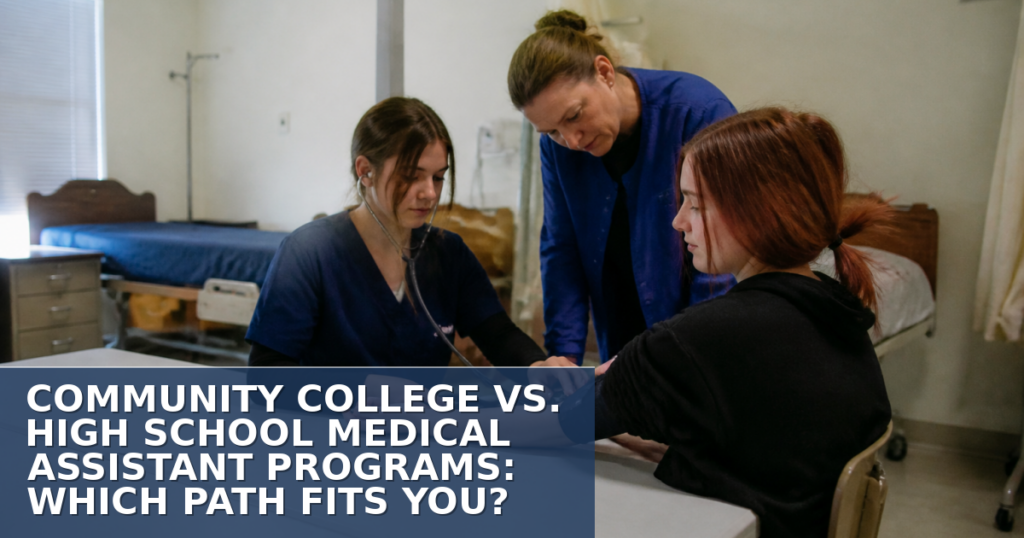
In Yuma, both certificate and associate degree medical assistant programs are available at Arizona Western College. Your choice often comes down to how quickly you want to enter the workforce and whether you plan to pursue further education.

Smaller metro areas face a straightforward reality when it comes to healthcare education: fewer local campuses mean fewer scheduling options for students juggling work or family responsibilities, especially in part-time medical assistant programs. For Yuma residents interested in medical assistant training, understanding which delivery formats actually exist locally versus which require looking beyond the immediate area can save significant time during your program search.
The Arizona Western College Medical Assistant Program in Yuma operates primarily as an on-campus program, with classes running Monday through Thursday from 7:00am to 5:00pm.2 The program takes two to four semesters to complete depending on your enrollment status.1 Rather than publishing a fixed modality (day-only or evening-only), AWC uses a section-based scheduling system where specific class times, days, and instructors vary each semester.2 This means you will need to check available sections during registration to see what fits your schedule for that particular term.
If you need evening or weekend options, AWC does offer a hybrid or blended Medical Assistant program through its La Paz County campus in Parker, Arizona. That location provides daytime, evening, and weekend scheduling flexibility.3 Parker is roughly 90 miles from Yuma, which may work for some students but adds considerable commute time.
Students hoping for a completely online medical assistant program should know that Arizona Western College does not list a fully online option for its Yuma campus.1 This matters because every medical assistant program, regardless of how coursework is delivered, requires a medical assistant externship with hands-on clinical hours. You cannot complete the credential without in-person training in a healthcare setting.
If you pursue an online program based elsewhere, you would need to coordinate your own clinical placement in the Yuma area or potentially travel for that portion of training. Before enrolling in any distance program, confirm in writing how externship placement works for students in your zip code.
For questions about AWC's Yuma program options, contact the department directly at [email protected] or (928) 344-7552.1
Arizona Western College's medical assistant program is ABHES-accredited and prepares graduates for the NHA CCMA exam1, giving Yuma-area students a local pathway to a nationally recognized certification.
Arizona Western College (AWC) is the main public college option for students who want to train without leaving Yuma County. The program is most often described as a certificate-level medical assistant path, and the college's program page lists a course fee of $100 per credit hour1. Exact credit totals for certificate and associate-degree tracks are not separated on the public program page, so students comparing a certificate with an associate degree should confirm the current AAS options and required credits with the college.
The ABHES medical assistant program accreditation is a major advantage because it supports eligibility for the NHA CCMA exam1, a credential many local employers recognize. Public program materials do not itemize the externship hour requirement, so it is reasonable to ask the program coordinator how many clinical hours are built into the schedule before you enroll.
Cost details should also be verified directly. A separate public cost listing associated with the college shows in-state tuition around $2,134, out-of-state tuition around $3,168, and about $1,186 in course fees2, but that listing is not presented as a full 2025-2026 tuition schedule. The $100 per-credit course fee is a helpful starting point, not a total program price.
Southwest Technical Education District of Yuma, or STEDY, is a career and technical education provider for the Yuma area. In the materials reviewed for this guide, STEDY does not have a publicly detailed medical assistant program page showing length, cost, schedule format, admission requirements, or certification exam eligibility. That does not mean a program is unavailable; it means you should contact STEDY directly, ask about current adult program enrollment, and request a current cost sheet before comparing it with AWC.
AWC's Yuma campus is the central in-person option for students from across Yuma County. Drive times can shift with border traffic and weather, but as a general guide:
For most local students, AWC and STEDY are the practical choices because the nearest additional medical assistant trade schools are concentrated in the Phoenix metro area, roughly 180 miles away. That distance makes regular in-person attendance unreasonable for most Yuma County residents, so a local accredited option is worth prioritizing.
A certificate can get you into a Yuma clinic in under a year, while an associate degree takes longer but may open doors to lead roles or further healthcare study down the road.
Most Yuma-area clinics and offices schedule externships during standard business hours, so working students should confirm a program offers flexible clinical placements before enrolling.
Some local hospitals and clinics prefer or require certification for hiring and pay differentials, so check job postings in your area before choosing a program that skips exam preparation.
Tuition, supplies, and lost wages during clinicals add up, so compare total program cost against available grants or payment plans before signing an enrollment agreement.
At Arizona Western College, the Medical Assistant A.A.S. total program cost is about $4,723 before financial aid. The first certification exam attempt is covered; the $165 exam fee reflects a retake if needed. Many Yuma students reduce out-of-pocket costs through Pell Grants, federal student loans, Arizona state grants like AzLEAP, AWC institutional aid, and WIOA funding available through the Yuma Private Industry Council.

Accreditation is the detail that determines whether your medical assistant training turns into a certification you can actually use, so it should be one of the first things you check before enrolling in a Yuma program.
The two names that matter most for medical assisting are the Commission on Accreditation of Allied Health Education Programs (CAAHEP) and the Accrediting Bureau of Health Education Schools (ABHES). An accredited medical assistant program with one of these stamps has met national standards for curriculum, instructors, and clinical training. That matters because the CMA (AAMA) credential has the tightest eligibility rules of the three main certifications. Under the standard education route, CMA (AAMA) applicants must graduate from a CAAHEP-accredited or ABHES-accredited medical assisting program.
If you are looking at AWC or STEDY, your next step is not the campus tour. It is confirming which accrediting body currently covers the specific medical assistant program you want. Here is how the certification paths generally line up:
The key point is that "accredited school" does not always mean "accredited for the CMA exam." Check the program's specific status, not just the college's overall name.
Arizona does not require medical assistants to hold a state license before working. However, most Yuma-area employers still prefer or require a national certification, and the CMA (AAMA) is commonly named in job posts because it signals a higher bar. If your local program cannot make you eligible for CMA, that is not automatically a dead end, but it narrows your options and may limit which employers consider you competitive.
Call or email the program coordinator and ask directly: "Does this specific medical assistant program hold current CAAHEP or ABHES accreditation, and which certification exams can recent graduates sit for?" For the CMA (AAMA), recent graduates are defined as applying within 12 months of graduation1, so do not let that window pass while you compare jobs. If you plan to pursue a less restrictive credential such as RMA or CCMA, confirm that your planned route fits that credential's current eligibility rules. This is the one enrollment question that is easier to ask before paying tuition than after completing a program.
Your classroom work builds medical assistant clinical skills, but the externship is where medical assistant training becomes real. Most medical assistant programs in Yuma, AZ require a supervised clinical rotation before you graduate, often in the range of 160 to 240 hours. Exact totals vary, so request the current clinical handbook from any program you are considering.
Arizona Western College generally coordinates externship placement through healthcare partners around Yuma. Students usually do not have to cold-call clinics on their own, but they should still expect to complete health screenings, immunizations, drug testing, and background checks before being cleared.
STEDY, the Southwest Technical Education District of Yuma, serves adult and secondary career training pathways. Its medical assistant students typically complete clinical hours at approved local sites, with instructors or program staff helping to match students to a setting that fits the schedule. Still, placement is not always automatic. Ask whether the program places you directly or simply provides a list of approved sites.
Yuma area students often rotate through several kinds of clinical settings: - Physician offices and primary care practices - Urgent care clinics - Yuma Regional Medical Center and affiliated outpatient departments - Community health centers and federally qualified health centers
Each setting builds a slightly different skill set. A primary care office may emphasize medical assistant clinical duties like rooming patients, vitals, and medication refills. An urgent care clinic may require faster intake, wound care support, and more flexible teamwork.
Externships in Yuma frequently turn into job offers, so it helps to keep medical assistant interview tips in mind. Local employers use clinical rotations to watch your reliability, communication, and clinical judgment before they post a position. Show up early, ask for feedback, and treat every patient interaction as part of the hiring process. Some Yuma area graduates are offered medical assistant jobs at the same clinic where they completed their externship.
Before you enroll, ask the program: - Are clinical sites pre-arranged by the school? - Can students suggest their own site, and who approves it? - What happens if a placement falls through? - Does the program provide malpractice or liability coverage during training?
That placement support can make or break your timeline, especially if you are balancing work, family, or a commute from nearby communities.
Yuma-specific wage data isn't published, so the closest official reference is the Arizona statewide median.
Medical assisting in Yuma sits at a familiar crossroads: local medical assistant salary tends to run below national figures, but lower living costs and steady demand for entry-level clinical staff make the area a practical place to start.
Across Arizona, May 2025 data shows the full spread for medical assistants:
Yuma's metro figures are reported from an earlier period, May 2022, and do not include the same percentile breakouts. In that release, Yuma employed about 440 medical assistants, with a location quotient of 1.27, meaning the occupation is more concentrated locally than it is nationally. The median hourly wage was $17.32, the mean hourly wage was $17.54, and the mean annual wage was $36,490.2
Nationally, BLS reports a median hourly wage of $20.19, with a 10th percentile around $16.10 and a 90th percentile around $27.15.3 Yuma's median of $17.32 is clearly lower, but the comparison needs context. Yuma's housing and everyday costs generally run below Phoenix and below many national metros. A new graduate earning in the mid-$30,000s or low-$40,000s can often cover more ground in Yuma than the same paycheck would in a higher-cost Arizona city.
The federal College Scorecard does not currently publish program-level first-year or second-year earnings for Arizona Western College medical assisting completers, so a true early-career wage for that program is not available. A separate college-wide earnings figure for former AWC students who received federal aid is about $36,857, but that number is not specific to medical assistant graduates and should not be read as a starting salary for the program.
National projections show medical assistant employment growing 12% from 2024 to 20344, faster than average, pointing to steady medical assistant job growth. Yuma's higher-than-average concentration of medical assistant jobs, combined with Health Professional Shortage Area designations in parts of the region and an aging local population, points to continued need for trained support staff and steady openings for entry level medical assistant candidates. In the Yuma market, outpatient care centers, specialty practices, and hospital systems tend to offer the stronger pay, while smaller independent clinics may start toward the lower end of the range.
Below are the top medical assistant programs serving Yuma students, ranked by completion data, accreditation status, and program fit. Each program card highlights the credential type, format, and local training details that matter most for working adults in the Yuma area.
Yuma, AZ · $3,000 – $10,000/yr (est.)
Best for: Yuma locals wanting nearby campus classes
Arizona Western College is the most direct local option for Yuma-area students, offering both a Medical Assistant certificate and a 60-credit A.A.S. occupational degree on its Yuma campus. Coursework covers medical terminology, human anatomy, medical office procedures, and front- and back-office clinical skills, with an externship built in. The program prepares students for the NHA CCMA exam, and campus-based classes generally run during weekday daytime hours, a practical fit for students who can attend in person.
Imperial, CA · under $5,000/yr (est.)
Best for: Imperial County commuters seeking clinical preparation
Imperial Valley College offers a Medical Assistant Certificate for Yuma-area learners willing to make the short commute across the California border. The 30-unit program combines administrative and clinical training, including medical terminology, anatomy and physiology, pharmacology, billing and coding, and electronic health records, with a required externship in local clinics and physician offices. It prepares students for the California Certifying Board for Medical Assistants exam and supports working students through financial aid and scholarships.
Start with Arizona Western College (AWC) if you want a local, accredited path. Visit AWC's allied health department page or call their admissions office to request a program info packet. STEDY may have a separate enrollment timeline for high school students and adult learners, so confirm those deadlines directly.

Medical assistant training in Yuma brings up practical questions about cost, time, and certification. Here are straightforward answers based on current program details for the Yuma area.
Arizona Western College lists $100 per credit hour, plus $1,211 in program fees, $199 for materials, and $165 for the NHA CCMA exam.1 A broader estimate puts total program cost at about $4,723 for in-state students and $5,757 for out-of-state students.2 The first CCMA exam attempt is included in the school's fee structure.
Timing varies. Arizona Western College describes its Yuma medical assistant program as taking two to four semesters.1 Other Arizona medical assistant programs can be completed in about nine months. Depending on the certificate path, plan for several months to roughly a year of coursework and clinical training.
Online components are available, but a fully online Yuma program is not clearly established. Pima Community College lists an online medical assistant certificate priced around $1,439 to $1,739.3 Arizona Western College also references online coursework, material fees, and in-person testing. Expect some lab, clinical, or proctored exam components in person.
The credential most clearly tied to Yuma training is the NHA CCMA, or Certified Clinical Medical Assistant. Arizona Western College's program prepares students for this exam and includes the first attempt in the stated fees.1 Other certifications are not clearly listed in current Yuma program materials, but students will still need to plan for how to renew medical assistant certification later.
No. Arizona does not require a state license to work as a medical assistant, consistent with broader medical assistant state license requirements.4 Licensing summaries list the requirement as no, with registration or licensure applying only in some states like Washington. Employers generally focus on completed training and certification rather than a separate state license.