Medical Assistant Programs in Springfield, Illinois
Compare accredited programs near Springfield — tuition, format, clinical hours, and career outcomes side by side.
By Jennifer GubblerReviewed by Editorial StaffUpdated August 29, 202621 min read
Most important takeaways…
Illinois does not license medical assistants, so employers set scope of practice.
Springfield Clinic, Memorial Health, HSHS St. John's, and SIU Medicine anchor jobs.
Community college tuition near Springfield runs from $3,700 to $6,100.
Where do Springfield medical assistants actually train, and how much does the credential matter?
Springfield Clinic, HSHS St. John's Hospital, and Memorial Health System anchor a healthcare market that keeps medical assistant openings active in a mid-size metro. Illinois does not license medical assistants at the state level, so the real gatekeeper is the hiring manager. Most employers now expect a completed accredited program plus a national credential such as CMA (AAMA) or CCMA through the NHA.
Medical assistant training near Springfield runs from community college certificates and associate degrees to hybrid CCMA prep, with costs, clinical hours, and medical assistant salary varying more by program format than by school name. Compare all of your local options before choosing.
How to Become a Medical Assistant in Springfield, IL
Illinois never asks you to weigh a license exam against a training schedule, because the state does not license medical assistants at all. That sounds like freedom, but it comes with a catch: your actual scope of practice is defined by the Illinois Medical Practice Act, which allows a physician to delegate patient-care tasks to you as long as you have appropriate training and a supervising provider on site. In practice, that means your employer, not the state, decides what you are trained and certified to do.
The Three-Step Pathway
Most people in the Springfield area follow the same general sequence regardless of which school they choose.
Complete an accredited program: Certificate tracks run roughly 9 to 12 months, while associate degree tracks stretch to about 18 to 24 months with added general education coursework.
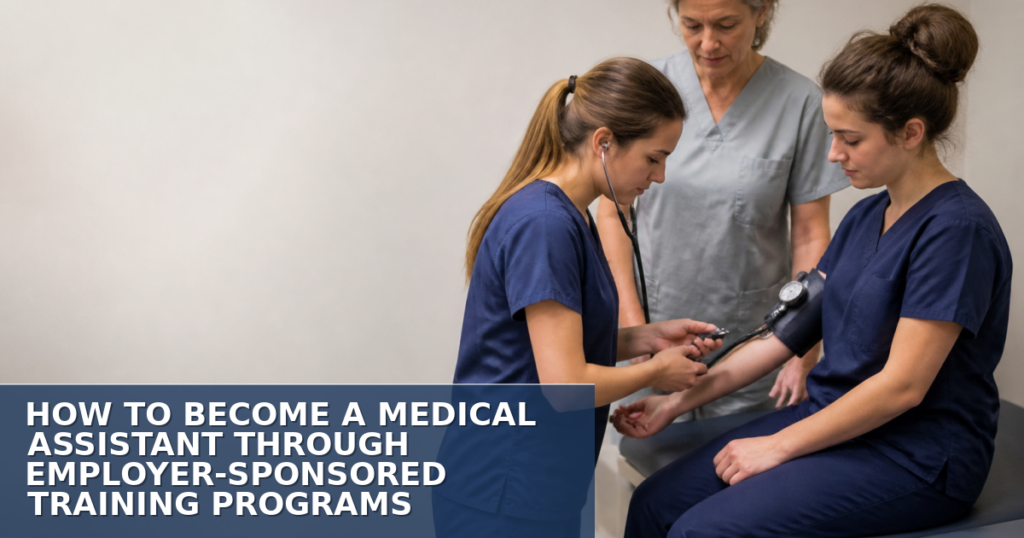
Finish a clinical externship: Hands-on hours in a real medical setting, typically arranged through your school, where you practice vitals, patient prep, specimen handling, and records work under supervision.
Sit for a national certification exam: The CMA through the American Association of Medical Assistants or the CCMA through the National Healthcareer Association are the two credentials employers recognize most.
Why Certification Feels Mandatory Even Without a Law Requiring It
No Illinois statute forces you to carry a CMA or CCMA credential. But look at job postings from major Springfield employers like Springfield Clinic and Memorial Health, and you will often see certification listed as required or strongly preferred. That employer-driven standard functions like a de facto requirement for anyone who wants a competitive shot at these roles, even though the law itself stays silent on it.
Who Can Enroll, and When
You do not need college credit to start. A high school diploma or GED is the standard prerequisite, which keeps the door open for recent grads and career changers alike. Several programs within driving distance of Springfield offer evening or weekend class blocks, which matters if you are working a day job while you retrain.
Certificate vs. Associate Degree
Certificate programs concentrate on clinical skills and get you into an externship faster. Associate degree programs take longer but layer in general education credits that can transfer toward a future nursing or health administration degree, which is worth considering if you see the MA role as a stepping stone rather than a destination.
Springfield's Healthcare Job Market for Medical Assistants
Springfield Clinic, one of the largest physician-owned multi-specialty practices in the United States, anchors the local medical assistant job market alongside Memorial Health, HSHS St. John's Hospital, and SIU Medicine. For a metro of roughly 200,000 people, that is an unusually dense concentration of healthcare employers, which is why medical assistant job growth here tends to be steadier than in markets that lean on a single hospital system.
Who Hires MAs in the Springfield Metro
The major employers you should know:
Springfield Clinic: Dozens of specialty and primary care locations across central Illinois, consistently one of the largest MA employers in the region.
Memorial Health: Operates Springfield Memorial Hospital plus a network of outpatient clinics and ExpressCare locations.
HSHS St. John's Hospital: Part of Hospital Sisters Health System, with affiliated physician practices hiring clinical support staff.
SIU Medicine: The academic practice tied to SIU School of Medicine, which posts MA roles requiring CMA, NCMA, CCMA, or RMA certification, a high school diploma or equivalent, and either graduation from an accredited medical assistant program or one year of relevant experience. Out-of-state hires must establish Illinois residency within 180 days.2
Independent and urgent care clinics: Smaller family medicine, pediatrics, and urgent care practices throughout the metro.
Commuting Range and Adjacent Markets
If you are willing to drive, the practical job radius expands considerably: Jacksonville (about 30 miles west), Taylorville (28 miles southeast), Lincoln (30 miles northeast), and Decatur (40 miles east) all pull from the Springfield labor pool. Champaign-Urbana sits about 85 miles east, further than most will commute daily but reasonable for a relocation.
A Shorter Education-to-Employment Pathway
Springfield Clinic has partnered directly with Midwest Technical Institute, offering current MTI medical assisting students up to $10,000 in tuition reimbursement (students are directed to contact their instructor, or the clinic at 217-527-8324, for details).1 That kind of employer sponsored medical assistant training is uncommon in most metros and shortens the distance between finishing school and starting a paid MA role. SIU Medicine job listings also advertise tuition reimbursement as a benefit, though the specific terms vary by posting.
Medical Assistant Training Options Near Springfield
Campus-Based Options in the Springfield Area
The medical assistant training programs around Springfield include a mix of community college, technical school, career center, and continuing education options. Most students are evaluating how each option fits their schedule, cost, and credential goals.
Lincoln Land Community College (LLCC): LLCC's clinical medical assistant program is a certificate program.1 The 2026 fall cohort runs Aug. 4 through Dec. 15, 2026, with 144 hours of classroom instruction and a 160-hour externship scheduled for Jan. 4 through Feb. 12, 2027.2 Classes meet Tuesdays and Thursdays from 5:30 to 9:30 p.m., so this is an evening-focused schedule. For the current cycle, LLCC does not list a daytime or weekend section.2
Midwest Technical Institute (MTI) Springfield: MTI is a local technical training option, but the 2026 day, evening, and weekend schedule details, program length, and whether the credential is a certificate or associate degree were not available in the materials reviewed. Contact MTI Springfield directly for the current format.
Capital Area Career Center: This Springfield-area center is another pathway some students consider, but current 2026 schedule options and certificate versus associate details were not verifiable in the available sources. Ask about format and clinical placements before applying.
UIS Continuing Education CCMA Program: The University of Illinois Springfield offers a continuing education route for CCMA preparation. Schedule, length, and delivery format can shift by term, so confirm the current format and whether it is fully campus-based or hybrid.
Schedule Flexibility for Working Adults
Many Springfield-area medical assistant students are already employed, so evening medical assistant classes, weekend, and hybrid options matter. LLCC's Tuesday/Thursday evening schedule is a strong example of a format built for people who work during the day. For MTI, Capital Area Career Center, and UIS Continuing Education, ask specifically about day, evening, weekend, and hybrid sections because the current 2026 schedules were not fully published in the sources reviewed.
Online and Hybrid Routes with Local Externships
If the local on-campus schedule does not fit, accredited online or hybrid programs from schools outside Springfield may be a practical alternative for Illinois students. The classroom or didactic portion can often be completed online, while a local Springfield-area clinic, physician office, or health system hosts the required externship hours. Before enrolling, confirm that the program is accepted for Illinois certification and that it can arrange or approve a Springfield-area clinical site. This can be especially useful if you need more flexible pacing than a fixed evening cohort.
Certificate vs. Associate: Know What You Are Comparing
LLCC's Clinical Medical Assistant offering is a certificate program by design, combining focused clinical and administrative training with an externship. Other schools may offer medical assistant training inside a broader associate's degree in medical assisting, which typically adds general education courses and takes longer. For MTI, Capital Area Career Center, and UIS CCMA, verify whether the credential is a certificate, associate degree, or noncredit continuing education award so you can compare total time and tuition accurately.
Accreditation and Certification: CAAHEP, ABHES, CMA, and CCMA Explained
Accreditation and certification are separate checks, and the smartest pre-enrollment move for Springfield students is to verify both with primary sources before committing to a medical assistant program.
In the Springfield program information available for 2026, Lincoln Land Community College is institutionally accredited by the Higher Learning Commission. Its medical assistant program page does not list CAAHEP or ABHES programmatic accreditation. Instead, LLCC states that medical assistant graduates are eligible for the CCMA exam through NHA. Students considering the CMA (AAMA) or RMA (AMT) credential should not assume that pathway applies to those exams.
How to Verify Programmatic Accreditation
Use the official CAAHEP and ABHES accredited program search tools and look up the exact program name shown in the school catalog. If a Springfield-area program does not appear, ask the school for its state approval status and current support documentation. Check the U.S. Department of Education's accreditation database separately to confirm the college or career school itself is institutionally accredited.
Search by exact program name: A campus may have multiple allied health programs, but programmatic accreditation is specific to the medical assistant track.
Ask for state approval: If CAAHEP or ABHES does not list the program, request written proof of state approval and current status.
Verify the institution separately: Use the U.S. Department of Education database to confirm institutional accreditation.
CMA, RMA, and CCMA Are Not the Same
The American Association of Medical Assistants, American Medical Technologists, and National Healthcareer Association each publish their own eligibility rules and exam prep resources. A program may describe itself as certification-focused without making graduates eligible for every credential. In the Springfield information reviewed for 2026, the clearest confirmed medical assistant pathway was LLCC's program leading to CCMA eligibility. LLCC also offers a separate medical administrative assistant track that points toward CMAA and CEHRS credentials, which is not the same as clinical medical assisting.
Confirm exam eligibility in writing: Contact the program director and ask which exams graduates can sit for in 2026, not just which preparation materials are used.
Recheck Before You Enroll
Accreditations and exam eligibility change over time. Cross-check the program website against CAAHEP, ABHES, the U.S. Department of Education database, and the certifying bodies' official lists. BLS.gov is a strong reference for occupation-level job data, but it does not accredit schools or confirm local program status. If a local program's status is unclear, treat that as a reason to ask more questions, not a reason to skip verification.
Clinical Hours and Externship Sites in the Springfield Area
Typical Clinical Hour Requirements
For most medical assistant certificate programs serving Springfield, externship hours often land in the 160 to 240 hour range, though associate degree tracks may require more. Lincoln Land Community College's Clinical Medical Assistant program, for example, includes 144 hours of classroom instruction followed by a 160 hour externship at one of the college's partner healthcare facilities.1 That 160 hour placement lines up with the minimums commonly referenced by CAAHEP and ABHES, but each program and accreditor can structure requirements a little differently. LLCC's CNA to Clinical Medical Assistant Bridge program is shorter, with a 60 hour clinical externship for students who already hold a CNA credential.2 Since the provided 2026 program information does not name specific Midwest Technical Institute or Capital Area Career Center externship hour totals, students should confirm those requirements directly with each school.
What to Expect During Clinicals
Clinical rotations are not observation-only. In a Springfield area externship, you should expect to move between front office and back office medical assistant duties under supervision. Front office work often includes scheduling, insurance verification, updating electronic health records, and checking patients in. Back office medical assistant clinical skills commonly include taking vitals, performing phlebotomy, giving injections, running EKGs, and helping with routine exam room setup. You may also practice patient communication, infection control, and documentation. The goal is to show you can handle the flow of a real medical office, not just pass a skills checklist.
Common Externship Settings in the Springfield Metro
Springfield's healthcare employers create a range of placement settings. Local externships often occur at Springfield Clinic locations, Memorial outpatient clinics, HSHS facilities, SIU Medicine clinics, and private physician offices. Some programs refer to assigned partner sites. Lincoln Land Community College states that its Clinical Medical Assistant program's medical assistant externship is completed at one of its partner healthcare facilities, which suggests the program arranges placement rather than asking students to secure a site on their own.1 Still, availability can shift from semester to semester. Ask a program coordinator which sites have hosted recent students and whether placement is guaranteed or best effort.
Ask About Placement Before You Enroll
Clinical site availability can affect when you finish. A delayed externship can push back your certification exam and job start. Before enrolling, ask about the program's externship placement rate, its current site partnerships in the Springfield area, and what happens if a site cancels. Clear answers help you plan around commute, hours, and timeline.
How Much Do Springfield-Area Medical Assistant Programs Actually Cost?
Community college medical assistant programs in the Springfield area list annual in-state tuition and fees from about $3,700 to $6,100, but program totals and private career school prices can be higher. Average net price after grant aid is often much lower, especially at public institutions where Pell Grant eligibility applies. Scorecard data shows median federal loan debt of $8,256 at Richland and $11,011 at Lincoln Land; Spoon River does not report median debt in this dataset.
Financial Aid, Tuition Reimbursement, and the UIS CCMA Program
You can approach medical assistant training as a pay-as-you-go certificate, or you can stack employer reimbursement, federal aid, and workforce grants to reduce what you actually pay. The right mix depends on whether you are already employed in healthcare and whether you choose a credit-bearing or noncredit program.
Federal and State Aid Basics
Most accredited medical assistant certificate and associate programs qualify for federal student aid through the FAFSA. If you are eligible, medical assistant grants such as Pell Grants and Illinois MAP grants can cover part of your tuition and fees before you borrow. Federal student loans can fill remaining gaps, but borrow conservatively because medical assistant wages in Springfield are modest. Ask the school's financial aid office whether the exact program is federal student aid eligible before enrolling, since noncredit continuing education options often follow different rules.
Springfield Clinic Tuition Reimbursement
Springfield Clinic can be a meaningful local cost offset if you are hired into an eligible role. Its tuition reimbursement pipeline generally covers qualifying education costs for employees, but participating schools and program agreements vary by current policy and department. The usual path is to get pre-approval from HR, complete an approved medical assistant program, and remain employed for the required period after reimbursement. This is especially useful for patient-facing roles that align with the clinic's staffing needs. Ask the education benefits team which Springfield-area programs are currently covered and whether part-time or PRN staff qualify.
UIS Continuing Education CCMA Program
The University of Illinois Springfield offers an online medical assistant program, the noncredit Online Clinical Medical Assistant Certification Training, through UIS Career Training. The current published price is $2,795, and that cost includes an NHA CCMA exam voucher at no additional charge.1 The program is listed as 540 instructional hours with 12 months of access, delivered online.1 Because it is noncredit, it may not use the same federal aid process as a credit-bearing certificate, so plan for out-of-pocket payment, a payment plan, or workforce funding. The 2026 listing does not specify a day, evening, or weekend cohort schedule, and it does not publish admissions prerequisites, so confirm those details directly with UIS before relying on them.
Workforce Development and WIOA
If you are changing careers or between jobs, Illinois workNet and WIOA may provide medical assistant training grants to eligible adults, dislocated workers, or lower-income applicants. Sangamon County workforce development programs can also point you toward short-term training grants that may offset medical assistant program costs. Availability and income rules change, so start with the local Illinois workNet office and ask whether the UIS CCMA program or a partner school is on the approved training list.
Medical Assistant Salary and Job Outlook in Springfield, IL
Medical assistant pay in Springfield, IL runs below the Chicago metro, but a lower cost of living can make those wages stretch further. According to 2024 BLS Occupational Employment and Wage Statistics, Springfield medical assistants earn a median annual wage of $40,600, with a 25th to 75th percentile range of $37,850 to $45,670. The table below compares Springfield to other Illinois metro areas.
Metro Area
Total Employment
Mean Annual Wage
25th Percentile
Median Annual Wage
75th Percentile
Springfield, IL
760
$42,470
$37,850
$40,600
$45,670
Chicago-Naperville-Elgin, IL-IN
18,130
$46,130
$40,460
$46,740
$49,980
Peoria, IL
710
$42,070
$37,590
$43,170
$44,320
Rockford, IL
700
$43,550
$38,790
$44,380
$46,360
Champaign-Urbana, IL
470
$42,740
$38,020
$42,930
$46,210
Bloomington, IL
400
$41,470
$36,300
$38,580
$44,220
Kankakee, IL
230
$39,790
$36,770
$37,390
$43,700
Decatur, IL
140
$41,970
$39,360
$40,580
$46,390
Medical assistants are among the fastest-growing healthcare support occupations in the country. The Bureau of Labor Statistics projects 15 percent job growth for medical assistants between 2023 and 2033, translating to roughly 119,800 new positions nationwide over the decade.
Accredited Medical Assistant Programs Serving Springfield Students
Below are the top medical assistant programs serving Springfield students, ranked by IPEDS completion data, accreditation status, and program fit. Lincoln Land Community College anchors the list in Springfield itself, while Spoon River and Richland offer commutable alternatives for learners in the surrounding area.
NCES-IPEDS federal institutional data — nces.ed.gov
Internal program database
Lincoln Land Community College
#1
Springfield, IL · $4,000 – $10,000/yr
Best for: Springfield locals balancing work and evening classes
Lincoln Land Community College is Springfield's home option, with a full Clinical Medical Assistant certificate and a shorter CNA-to-CMA Bridge for experienced aides. Both tracks run on campus in the evening to accommodate working adults and include CCMA exam preparation; the full program adds 160 clinical hours and the bridge requires 300 prior CNA hours.
$4,490 total program tuition
160 clinical hours via partner-facility externship
Evening classes twice per week
Prepares for Certified Clinical Medical Assistant (CCMA) exam
Best for: West-central Illinois commuters wanting supervised internships
Spoon River College in Canton offers a three-semester Medical Assistant Certificate with a supervised internship and phlebotomy and First Aid training. The campus-based format is a practical option for west-central Illinois learners who can make the commute to the Canton campus.
Best for: One-year learners focused on certification prep
Richland Community College in Decatur provides a one-year Medical Assisting Certificate focused on both administrative and clinical skills for ambulatory care settings. The program prepares students for a national certification exam and offers direct program contacts, making it a practical choice for learners east of Springfield.
Do you picture yourself at a large multi-specialty practice like Springfield Clinic, which often prefers the CMA (AAMA) credential, or at a smaller outpatient clinic that widely accepts the CCMA (NHA)?
Springfield Clinic and large hospital-owned groups often list CMA (AAMA) as preferred or required, while many independent and specialty offices treat CCMA (NHA) as equally acceptable for entry-level roles.
Are you willing to complete a CAAHEP- or ABHES-accredited program needed for CMA (AAMA) eligibility, or do you need a faster and more flexible route that qualifies you for the CCMA (NHA) instead?
CMA (AAMA) eligibility generally requires completing an accredited program, so this choice can rule some local Springfield programs in or out before you enroll. CCMA (NHA) qualification often fits shorter certificate or hybrid options.
Does long-term advancement into clinical management or specialty certification matter to you, and does the credential you choose support that path?
Both credentials can lead to lead medical assistant roles, but supervisory and specialty positions may state a credential preference. Checking current Springfield job postings at your target employers can show which one appears more often on advancement tracks.
Frequently Asked Questions About Medical Assistant Programs in Springfield
These are the questions prospective medical assistants ask most often about training near Springfield. Answers reflect the local program options and certification guidance covered elsewhere in this guide.
QHow long does it take to become a medical assistant in Springfield, IL?
AMedical assistant program length varies by format. Hybrid programs in the Springfield area can take 14 to 18 weeks.1 The Midwest Technical Institute medical assisting program runs about 9 months.3 The University of Illinois Springfield online clinical medical assistant option allows up to 12 months.4 Most certificate paths range from roughly three months to one year depending on schedule and clinical hours.
QDo you need certification to work as a medical assistant in Illinois?
AIllinois does not require state licensure for medical assistants, but many employers expect or prefer a national credential.2 Springfield area programs prepare students for exams like the CCMA, and the benefits of medical assistant certification can improve hiring prospects even though it is not legally mandatory in Illinois.
QWhat is the difference between CMA and CCMA certification?
ACMA vs CCMA certification involves separate national credentials from different certifying bodies. CMA is issued by the American Association of Medical Assistants. CCMA is issued by the National Healthcareer Association. Each has its own eligibility and exam rules. Springfield area training options may prepare you for one or the other, so choose a program aligned with your credential goal.
QAre there accredited medical assistant programs in Springfield, IL?
AYes, several accredited or programmatically recognized options serve Springfield students, including Lincoln Land Community College, Midwest Technical Institute, Ozarks Tech, and Springfield Medical Assistant School. Fox College holds ABHES accreditation,5 but not every Springfield program carries the same programmatic status, so verify accreditation directly with each school before enrolling.
QWhat is the average salary for a medical assistant in Springfield, IL?
AThe national median annual wage for medical assistants is about $44,200.2 That figure is not Springfield specific, so local pay can vary by employer, experience, credential, and practice setting. For Springfield area context, compare current local job postings or consult the salary and outlook section of this guide.
QCan I complete medical assistant training online from Springfield?
AYes, online and hybrid options are available near Springfield. Ozarks Tech offers lectures online with on-campus labs. Springfield Medical Assistant School combines online learning with in-person practice.1 University of Illinois Springfield offers an online clinical medical assistant certification that can be completed in up to 12 months.4 Clinical skills still require in-person hours.