Your Guide to Medical Assistant Schools in Nashville, TN
Compare accredited programs, costs, externships, and career outcomes for Nashville-area medical assistant training.
By Jennifer GubblerReviewed by Editorial StaffUpdated August 28, 202622 min read
Most important takeaways…
Nashville healthcare generates $72.1 billion in output and supports 370,000 jobs.
Vanderbilt University Medical Center externships often lead straight to full-time MA jobs.
Tennessee requires no medical assistant license, but hospitals often prefer CMA certification.
Choosing a medical assistant program in Nashville usually comes down to a real tradeoff: a fast, low-cost community college certificate that gets you working in about a year, or a longer associate degree that costs more but transfers toward nursing or health sciences later.
Nashville is a rare training market because the employer base is unusually deep. HCA Healthcare is headquartered here, Vanderbilt University Medical Center anchors the academic side, and Ascension Saint Thomas plus dozens of outpatient networks feed steady demand for credentialed MAs in the medical assistant primary care role.
Tennessee does not license medical assistants at the state level, but most Nashville hospital systems expect national certification (CMA through AAMA or RMA through AMT) on the medical assistant resume, and program accreditation through CAAHEP or ABHES is what makes you eligible to sit for those exams.
Jump straight to the program list below.
Nashville's Healthcare Job Market for Medical Assistants
How strong is the Nashville job market for medical assistants, and which hospital systems actually hire new graduates?
A Healthcare Hub, Not Just a Music City
Nashville is consistently treated as one of the busiest healthcare employment markets in the country. The city is home to HCA Healthcare's corporate headquarters, Vanderbilt University Medical Center, Ascension Saint Thomas, TriStar Health, and Community Health Systems. That concentration matters because each system runs hospitals, outpatient clinics, and physician practices that need medical assistants in front office and back office roles. In available wage data, Vanderbilt University Medical Center, HCA Healthcare, and Tennessee Oncology show up among the names most associated with medical assistant hiring and higher pay in the metro. That spread reduces the risk of training for a single employer and creates multiple entry points after graduation.
What Medical Assistants Earn in the Nashville Metro
The Nashville-Davidson-Murfreesboro-Franklin MSA reports a median annual medical assistant salary of about $44,620.1 That sits right at the national median of $44,2002, so Nashville is roughly average on pay rather than a clear high-wage outlier. For a useful range, national figures show the 10th percentile around $35,020 per year or $16.84 per hour, while the 90th percentile reaches $57,830 per year or $27.82 per hour.2 New graduates should expect to start closer to the lower end, while experienced medical assistants who take on specialty or lead roles can move toward the upper end through medical assistant career advancement. For prospective students, the metro median is a practical anchor: it is not a wage leader, but it is a stable, large-volume market.
Where the Jobs Are and Who Can Reach Them
One practical advantage of training in Nashville is the surrounding commuter ring. Murfreesboro, Franklin, Hendersonville, Clarksville, and Gallatin all feed into the same healthcare job market. A student who lives in Franklin or Hendersonville can attend medical assistant schools in Tennessee and still access the same hospital systems and clinical networks without relocating into the city center. The same applies in reverse: a Nashville resident can consider clinical sites or employer locations in those nearby cities.
Growth Outlook: A Market That Keeps Adding Jobs
Nationally, BLS projects medical assistant employment to grow much faster than average, and Nashville's sustained population growth plus hospital expansions add local demand on top of that. As big systems add outpatient clinics and specialty practices across Middle Tennessee, medical assistant roles tend to follow directly. That does not guarantee a job for every graduate, but it means the region has more than one major hiring pipeline. This combination of national tailwinds and local expansion is the main reason Nashville is considered a strong MA job market rather than just a single-hospital town.
Do Medical Assistants Need Certification in Tennessee?
Tennessee does not require medical assistants to hold a state-issued license, registration, or state board exam to work in the field generally.1 Medical assistants may work under physician supervision without a state credential. That legal flexibility, however, does not erase the benefits of medical assistant certification in the Nashville job market. Large local employers such as Vanderbilt University Medical Center, HCA Healthcare, and TriStar Health routinely require or strongly prefer national certification for clinical MA roles. In practice, you can be legally eligible to work while still being screened out of the best Nashville-area positions if you do not hold CMA (AAMA) or RMA (AMT) certification.
The Ambulatory Clinic Exception
Tennessee does regulate one specific setting: ambulatory outpatient hospital clinics. Under Tennessee Code § 68-11-244, a person working as a certified medical assistant in those clinics must be at least 18 years old, have completed 12th grade or an equivalent, and hold certification from AMT, AAMA, NCCT, NHA, or NAHP.2 If you plan to work in a hospital-based outpatient clinic in Nashville, certification is not a nice-to-have. It is the baseline qualification for that job title.
CMA vs. RMA: Why School Accreditation Matters
The certification you pursue affects which Nashville program you should choose. The CMA (AAMA) route is generally tied to graduation from a CAAHEP-accredited medical assisting program. The RMA (AMT) route accepts programs accredited by either CAAHEP or ABHES. This is one of the most practical reasons to check a school's accreditation before enrolling. A Nashville program with ABHES but not CAAHEP accreditation may still prepare you for RMA certificationRMA certification, but it may not satisfy CMA eligibility. If your target employer prefers CMA, that distinction could delay your job search.
What Tennessee MAs Can and Cannot Do
Medical assistants in Tennessee perform delegated clinical tasks under the supervision of a physician or licensed nurse. The state statute lists medical assistant duties and responsibilities such as vital sign measurement, phlebotomy, simple dressing changes, collection of medical history data, and preparation of patient care areas.2 In many Nashville practices, delegated tasks also include EKGs and injections, but injection authority is generally shaped by physician delegation and employer policy rather than a blanket statewide rule. MAs cannot prescribe medication, make independent medical diagnoses, or practice independently. As of 2026, there is no widely reported pending state legislation that would change certification, supervision, or scope of practice for Tennessee medical assistants.3
Accreditation Decoded: CAAHEP Vs. ABHES and Why It Matters
Only two accrediting bodies matter when you are comparing accredited medical assistant trade schools: CAAHEP (the Commission on Accreditation of Allied Health Education Programs) and ABHES (the Accrediting Bureau of Health Education Schools). If a Nashville program cannot show one of those two seals on its MA track specifically, you should treat it as a red flag regardless of how polished the campus or the recruiter looks.
Why regional accreditation alone will not cut it
Many Nashville-area schools carry regional or institutional accreditation, which is what lets them award degrees and accept federal financial aid. That is not the same thing as programmatic accreditation for medical assisting. The AAMA (which grants the clinical medical assistant certification) requires that you graduate from a CAAHEP-accredited program, full stop. The AMT (which grants the RMA credential) is a bit more flexible and recognizes both CAAHEP and ABHES. So if your school is regionally accredited but its MA program has no CAAHEP or ABHES stamp, you can graduate with a certificate in hand and still be locked out of both national exams. That is a costly mistake to discover after the fact.
Which Nashville-area programs hold what
Based on the most current listings we could verify:
South College (Nashville campus): CAAHEP-accredited medical assisting certificate, initially accredited in September 2021, with the next scheduled evaluation no later than Fall 2030.2 This is the cleanest, most current programmatic accreditation on a Nashville campus in our review.
Fortis Institute (Nashville): Historically ABHES-accredited for its medical assisting diploma, though the only expiration date we could confirm from public listings was February 28, 2022.1 Prospective students should ask Fortis directly for a current ABHES letter before enrolling.
Within commuting or short-drive range of Nashville: Volunteer State Community College (Gallatin) is CAAHEP-accredited, as are Chattanooga State and Cleveland State further east.2
For other schools in the metro that advertise medical assistant training, including Nashville State Community College and Genesis Career College, we could not verify a current CAAHEP or ABHES listing at the time of writing. That does not automatically mean the programs are unaccredited, but it does mean the burden is on the school to show you a current certificate before you sign an enrollment agreement.
What to ask before you enroll
Call the program director and ask three questions: Which body accredits this specific MA program, CAAHEP or ABHES? What is the current accreditation expiration or next evaluation date? Will graduates be eligible to sit for the CMA exam, the RMA exam, or both? If you get vague answers, walk. The CAAHEP and ABHES public directories list every currently accredited program, and any legitimate school will be happy to point you to their entry.23
CMA Vs. RMA: Which Credential Do Nashville Employers Recognize?
In the Nashville area, hospital systems and larger multispecialty clinics frequently name the CMA (AAMA) credential in job postings, while independent practices and many physician offices accept either. If your goal is a hospital-owned clinic, the CMA (AAMA) is generally the safer default, though an RMA (AMT) can still open doors in outpatient settings.
Tuition and Total Cost Comparison Across Nashville Programs
These three Nashville-area options show the cost spread between public certificate programs and a private associate degree. Net price is an institution-wide average after grants and scholarships, not a program-specific price, so contact the financial aid office for a personalized estimate. A certificate can often be completed in 9 to 12 months and usually costs less total than a 24-month associate degree, but the associate may support more advancement later.
School
Program
Credential
Location
In-State Tuition
Out-of-State Tuition
Net Price After Aid
Columbia State Community College
Certified Clinical Medical Assistant (CCMA) Program
Certificate or Diploma
Columbia, TN
$5,296
$18,112
$4,734
Volunteer State Community College
Certified Clinical Medical Assistant Certification Program
Certificate or Diploma
Gallatin, TN
$4,756
$17,740
$7,802
Remington College-Nashville Campus
Medical Assisting
Associates
Nashville, TN
$16,258
$16,258
$29,098
Certificate Vs. Associate Degree: Which Path Fits You?
Choosing between a certificate and an associate degree in medical assisting comes down to your timeline and long-term goals. Both routes can prepare you for CMA or RMA exams, but they differ in depth, cost, and transferability. If your goal is to start working quickly in a clinical support role, a certificate is efficient, while an associate degree has more long-term value for office management or nursing bridges.
Strengths
Trade-offs
A certificate typically takes under 12 months, so you can enter the workforce and start earning quickly.
Certificate programs skip general education courses, so you miss the broader communication and management coursework found in an associate degree.
You pay less total tuition than for an associate degree, which keeps debt lower for an entry level clinical role.
An associate degree is stronger if you want supervisory, patient coordination, or specialty roles that prefer more formal education.
Certificate hours meet CMA or RMA exam eligibility, so you can earn a nationally recognized credential without general education courses.
Associate credits transfer more easily into a bachelor's in healthcare administration, while certificate credits may not apply.
At Nashville State Community College, you can complete the certificate first and stack it into the A.A.S. later if your goals change.
A certificate alone may limit advancement later, especially if you decide to bridge toward nursing or office management.
Questions to Ask Yourself
Can I realistically attend day classes, or do I need evening, weekend, or hybrid options?
If you're keeping a job while training, a rigid daytime cohort can force you to quit or drop out. Nashville programs vary widely on scheduling, so confirm the format before you enroll.
Is the program accredited by CAAHEP or ABHES, and does that match the certification I want?
The CMA exam requires CAAHEP or ABHES accreditation; the RMA is more flexible. Picking the wrong accreditation can block you from your target credential entirely.
Where will my externship actually place me?
Externships often turn into job offers, so a placement at Vanderbilt, HCA TriStar, or Ascension Saint Thomas matters more than a generic clinic rotation. Ask for a list of current externship sites before signing.
Clinical Externships and the VUMC-NSCC Pipeline
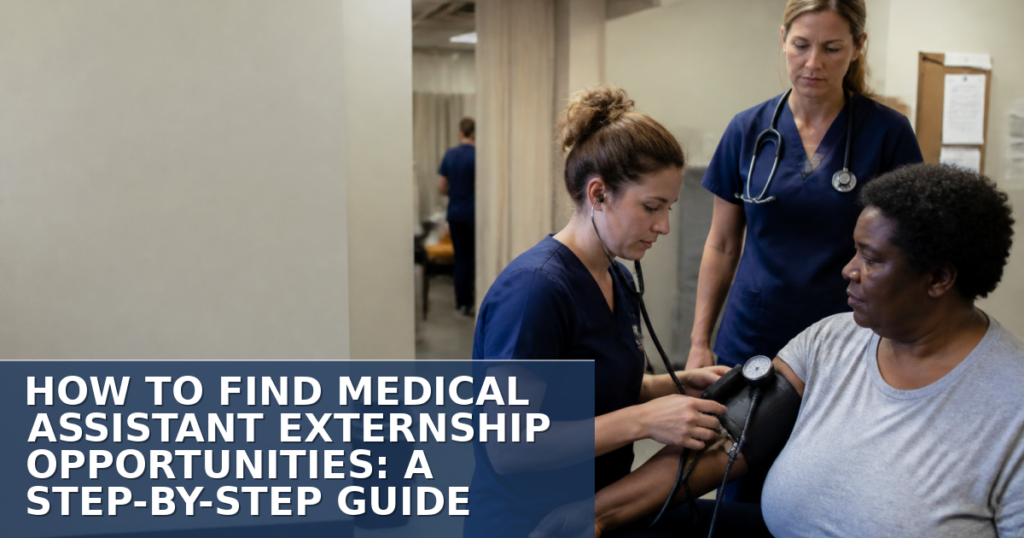
Medical assistant externships in Nashville are not just a graduation requirement; at the major hospital systems they are often the most direct route into a full-time medical assistant job.
How the VUMC-NSCC externship is structured
Vanderbilt University Medical Center and Nashville State Community College run a 12-week medical assistant training program that packs classroom instruction and clinical time into one tight schedule. Students spend four weeks in NSCC classrooms and eight weeks in a VUMC clinical preceptorship. The program totals 384 hours: 128 didactic hours and 256 clinical hours.1 Preceptors are VUMC medical assistants and nurses, and students take the CCMA exam on the last day of class.1
The 2026 calendar is built around four cohorts. Start dates are January 20, April 20, July 13, and September 28, with application windows opening roughly three months before each start.1 If you are planning around a job or family schedule, those start dates matter because the program is intensive and cohort-based. The clinical setting is described as VUMC medical clinics or various VUMC clinical departments rather than a fixed site list, so your specific preceptorship location will likely be assigned after you are accepted.1
The hiring pipeline effect
Large Nashville systems like VUMC, HCA Healthcare, and Ascension Saint Thomas often treat clinical externships as extended working interviews. That is especially true for VUMC-NSCC students, who spend 256 hours inside VUMC clinics before graduation. In that time, preceptors and department managers see your reliability, clinical skills, and patient communication up close. Many externs receive job offers before their program ends. This is not a written guarantee, but it is a consistent advantage of training inside a system that is actively hiring.
What to expect at other Nashville programs
Externship details are less visible at some other Nashville campuses. Public materials for Fortis Institute Nashville, South College Nashville, and Genesis Career College do not specify externship hours, placement guarantees, or clinical site lists. That does not mean these programs lack externships; it means the structure can vary by campus or cohort. Before you enroll, ask admissions directly about a few things:
Guaranteed placement: Does the school assign your clinical site, or will you need to find your own?
Clinical hours: Exactly how many externship hours are required, and where have recent cohorts been placed?
Site agreements: Which Nashville facilities currently have active contracts with the program?
A separate NSCC partnership with Matthew Walker Comprehensive Health Center runs for nine weeks and includes one week of orientation followed by eight weeks at 32 hours per week.2 That program is distinct from the VUMC-NSCC track, so confirm which partnership you are applying to if you see NSCC listed in multiple places.
Online, Hybrid, and On-Campus Options in Nashville
The shift toward flexible learning formats has made medical assistant training more accessible than ever, but the profession's hands-on nature means fully remote programs still come with an in-person catch.
Searching for "Online Medical Assistant Programs Nashville"
If you search for online medical assistant programs in Nashville, you will find national schools that enroll Tennessee students alongside local options. Nashville State Community College, for example, offers an online Certified Clinical Medical Assistant (CCMA) course with no prerequisites to enroll, though you will need a high school diploma or equivalent to sit for the national certification exam.1 Nationally accredited online programs from schools outside Tennessee also accept Nashville-area students. Here is the important caveat: no matter where the classroom lectures happen, clinical and externship hours must be completed in person at a site in the Nashville area. Every accredited pathway requires you to draw blood, take vitals, and assist with procedures under supervision, and there is no virtual substitute for that.
On-Campus Programs and What They Offer
Several Nashville-area schools deliver their medical assistant training entirely on campus. Remington College's Nashville campus runs a 24-month associate degree program with hands-on lab work, anatomy and physiology courses, and a built-in externship. Columbia State Community College in Columbia offers a certificate program with 140 hours of classroom and lab instruction plus a 160-hour clinical externship. Volunteer State Community College in Gallatin runs a 10-month campus-based certificate that covers patient care, phlebotomy, and EKG training.
The advantage of fully on-campus programs is straightforward: more face time with instructors, tighter relationships with local clinical sites, and immediate access to lab equipment. If you live in Nashville proper, commuting to any of these campuses is manageable.
Hybrid Formats and Flexibility for Working Adults
Hybrid programs, where you complete didactic coursework online and attend labs on campus, are the sweet spot for students commuting from Murfreesboro, Clarksville, or Franklin. Reducing the number of days you need to be physically on campus can shave hours off a weekly commute and make it possible to hold a job while in school.
Detailed hybrid scheduling information for specific Nashville-area programs is limited in current published materials. If a hybrid format is important to you, contact admissions directly and ask whether lecture components can be completed remotely and how often on-campus lab sessions meet.
Evening and Weekend Cohorts
If you work full-time, evening or weekend cohorts can make the difference between enrolling now and waiting another year. Some Nashville-area programs have historically offered evening medical assistant classes, but confirmed evening or weekend cohort availability for the current academic year is not widely published. Before you commit, call the program and ask two specific questions: "Do you offer evening or weekend lab sessions?" and "Can I complete the externship during non-standard hours?" Clinical sites sometimes have their own scheduling constraints, so the externship piece matters just as much as the classroom schedule.
Choosing the Right Format
Here is a quick way to think about the trade-off:
Fully online didactic plus local externship: Best if you live 30 or more miles from campus and need maximum scheduling control.
Hybrid (online lectures, on-campus labs): A middle ground that keeps you connected to instructors and classmates while cutting commute days.
Fully on-campus: Ideal if you thrive with structured, daily in-person learning and want the strongest possible relationship with clinical partners.
No single format is objectively better. The right choice depends on your commute, your work schedule, and how much structure you need to stay on track.
Nashville Medical Assistant Programs Ranked by Outcomes
Below are the top medical assistant programs serving Nashville students, ranked by federal completion data, accreditation status, and program fit. The list includes public community college certificates and a Nashville-based associate degree, so compare cost, timeline, and clinical placement before choosing.
NCES-IPEDS federal institutional data — nces.ed.gov
Internal program database
Independent program research
Columbia State Community College
#1
Columbia, TN · ~$5,000/yr (est.)
Best for: Budget-conscious certificate seekers
Columbia State Community College offers a public, lower-cost route into medical assisting through a certificate program that pairs 140 hours of classroom and lab training with a 160-hour clinical externship. The school's overall graduation rate is 30%, and its net price is among the most affordable in the Nashville area. Program-level one- and two-year earnings are not yet reported, but the school's institutional earnings outcomes are solid for certificate-level training. Columbia is south of downtown Nashville, so most students drive rather than rely on public transit.
140 hours of classroom and hands-on lab instruction
160-hour clinical externship at a local healthcare provider
Best for: Hands-on learners needing phlebotomy and EKG
Volunteer State Community College in Gallatin runs a ten-month CCMA certificate that combines 60 classroom and lab hours and 80 clinical hours per course, covering patient care, phlebotomy, and EKG. Its $2,745 total program cost and certificate-level structure make it an efficient, hands-on option for the broader Nashville market. The school's overall graduation rate is 28%, and program-level one- and two-year earnings are not yet reported. Gallatin is northeast of downtown Nashville, accessible by car and some regional transit routes, and graduates often pursue externships in Nashville-area hospitals and physician practices.
$2,745 total program tuition
10-month campus program
Prepares for National Healthcareer Association (NHA) certification
Includes patient care, phlebotomy, and EKG training
Each course combines 60 classroom/lab hours and 80 clinical hours
Background check and drug screening required
Requires medical insurance and vaccines
Fees cover study guides and supplies; certification exam fees not included
Best for: Nashville-based associate degree seekers
Remington College's Nashville campus offers a 24-month associate degree in medical assisting with both clinical and administrative training. Tuition includes CCMA and CPR certification costs, and an externship provides real-world experience at Nashville-area sites. The school's overall graduation rate is 47%, and program-level one- and two-year earnings are not yet reported. Its campus in Nashville places students near downtown employers and transit options, and the associate pathway can support later career advancement.
Nashville's healthcare ecosystem is bigger than most people realize. According to the Nashville Health Care Council's economic impact study, the region's health care industry generates roughly $72.1 billion in annual output and supports more than 370,000 jobs, making it one of the largest healthcare hubs in the country.
Frequently Asked Questions About MA Programs in Nashville
These are the questions prospective medical assistants ask most often when comparing Nashville-area programs. Answers reflect program details and hiring patterns in the Nashville metro as of August 2026.
QHow long does it take to become a medical assistant in Nashville?
AMost Nashville-area certificate or diploma programs take roughly 3 to 12 months. Remington College lists a 9-month diploma.1 Volunteer State Community College reports a 10-month program.2 The Vanderbilt/NSCC pathway runs about 12 weeks.3 If you choose an associate degree, you may take roughly 14 to 24 months to become a medical assistant.4
QCan you become a medical assistant online in Tennessee?
ASome Tennessee training is available online, but many Nashville programs are hybrid because clinical skills need hands-on practice. An online CCMA course may take about 12 months with no prerequisites,5 while the Vanderbilt/NSCC option combines classroom work at NSCC with clinical hours at VUMC rather than being fully online.3 Check each program's delivery format before enrolling.
QWhat is the difference between CMA and RMA certification?
ACMA stands for Certified Medical Assistant and RMA stands for Registered Medical Assistant. The RMA vs CMA choice involves separate certifying bodies and exam rules, but both are recognized credentials for medical assisting jobs. Nashville employers generally care more that you have recognized certification plus relevant training or experience than which specific credential you hold.
QDo Nashville employers require medical assistants to be certified?
ATennessee does not have a statewide licensing mandate for medical assistants, and Nashville-area job postings are not universal in requiring certification. That said, medical assistant certification is commonly preferred or expected, and many Nashville programs prepare students for the Certified Clinical Medical Assistant credential or similar exams.2 Earning certification can make you more competitive even where it is not strictly required.
QWhat are the admissions prerequisites for Nashville MA programs?
ACommon requirements include a high school diploma or GED. Some campus programs may also ask for an entrance interview, official transcripts, immunizations, a clean criminal record, or minimum age of 18. The Vanderbilt/NSCC program specifically requires a diploma or GED.3 One online CCMA course lists no prerequisites, but that is an online course rather than a campus-based program.5