Most important takeaways…
- Dallas medical assistants earn a median wage of $43,100.
- Tuition ranges from under $4,000 to over $27,000 in Dallas.
- Most programs require 80 to 240 hours of clinical externship.
Compare accredited programs, tuition, and formats to find the right fit for your career in the Dallas–Fort Worth area.
Dallas supports more than 30 hospitals and hundreds of outpatient clinics across systems like Baylor Scott & White, UT Southwestern, Parkland Health, and Texas Health Resources, all of which rely on trained medical assistants to keep daily operations running. That concentration of employers translates to consistent hiring and a local median wage of $43,100, above both the state and national figures.
Program options here range from community college certificates costing under $4,000 to private trade school diplomas that can exceed $27,000, with most completable in 7 to 12 months. Sorting through cost, schedule flexibility, and finding accredited medical assistant programs that offer certification eligibility is the real challenge for prospective students.
The Dallas metro is home to some of the largest and most respected health systems in Texas. Baylor Scott & White Health, UT Southwestern Medical Center, Parkland Health, Texas Health Resources, and Medical City Healthcare all operate multiple hospitals, specialty clinics, and outpatient centers across the region. These organizations hire medical assistants year-round for roles in primary care, urgent care, cardiology, pediatrics, and beyond. Because each system runs network-wide career portals, a single application can open doors at dozens of locations, making the job search scale-friendly for new graduates.
Texas does not require medical assistants to hold a state-issued license.1 This lowers the barrier to entry compared to states that mandate licensure. However, Dallas-area employers almost uniformly prefer or require a national credential. The three most recognized certifications are CMA (Certified Medical Assistant from the AAMA), RMA (Registered Medical Assistant from AMT), and CCMA (Certified Clinical Medical Assistant from NHA).1 Earning one of these signals to hiring managers that you have met a national standard and are ready to work safely under supervision. Many accredited medical assistant programs in Texas, including Dallas-area schools, align their curricula with one or more of these exams, so you can graduate test-ready.
The job market extends well beyond downtown Dallas. Fort Worth, Arlington, Plano, Irving, and Garland each have their own clusters of hospitals, medical office buildings, and specialty clinics. Many MA graduates find positions closer to home by targeting these satellite healthcare corridors. Commuting options such as DART light rail, TRE, and major highways make it feasible to work in one suburb while living in another, giving you flexibility to follow the best offer.
Under Texas delegation rules, medical assistants can perform a wide range of clinical tasks as long as a licensed provider delegates and supervises the work.4 That means Dallas MAs often draw blood, give injections, perform EKGs, and assist with minor procedures3. These duties are restricted or off-limits in more regulatory states. You cannot independently diagnose, prescribe, or interpret test results2, but the clinical variety makes the role engaging and can strengthen your resume if you later pursue nursing, PA school, or other advanced practice paths.
In the Dallas-Fort Worth-Arlington metro area, medical assistants earn a median wage of $43,100, outpacing both the Texas statewide median of $39,520 and the national median of $42,000. Certified professionals often land toward the higher end of the range, with top earners reaching $55,620. This strong local pay, combined with projected job growth of 13% nationally through 2034, makes Dallas a promising place to launch an MA career.

Balancing speed against flexibility is the core tradeoff most working adults face when choosing a medical assistant program. A faster timeline gets you into the workforce sooner, but rigid daytime schedules can clash with a job or family responsibilities. The good news: Dallas-area schools have responded with a wide range of formats designed for people who can't sit in a classroom five days a week.
Certificate programs are the quicker route. Across the Dallas-Fort Worth metro you will find certificates ranging from roughly 12 weeks to 13 months, depending on the school and format. An associate degree in medical assisting typically takes about two years of full-time study. The tradeoff is straightforward: certificates get you working faster, while an associate degree earns you transferable college credits that can count toward a future bachelor's in healthcare administration or a related field. If your primary goal is to start earning a paycheck as a medical assistant, a certificate is usually the most practical choice.
One of the biggest differentiators among Dallas-area programs is schedule flexibility. Several schools offer evening medical assistant classes and weekend cohorts built specifically for students who work during the day.
When comparing medical assistant training programs, ask whether the evening or weekend cohort follows the same curriculum and clinical hours as the daytime track. You want the same training quality regardless of when you attend.
If you are commuting from Fort Worth, Plano, Garland, or elsewhere across the sprawling DFW metro, a hybrid format can save hours of driving each week. Programs like CCI Training Center deliver coursework through live online classes (completable in about seven months)6, while CTK Healthcare and Career Institute pairs online lectures with one day per week of in-person clinicals over roughly six months.7 Dallas College offers a 13-month certificate that begins with an online first semester before shifting to on-campus daytime classes for labs and clinical rotations.8 Keep in mind that every accredited program will require hands-on lab time and an externship, so fully online completion is not an option for medical assisting.
Some medical assistant trade schools advertise accelerated or self-paced formats that can compress the timeline even further. These programs can be genuinely convenient, but they often carry higher tuition than community college alternatives. Before committing, compare the total cost against a slightly longer program at a community college. Finishing a few weeks sooner doesn't always justify thousands of extra dollars in tuition or debt. Weigh the speed benefit against what you will actually pay, and make sure the school holds recognized programmatic accreditation so your credential carries weight with employers and certification bodies.
Programs with flexible scheduling let you maintain income and avoid gaps in employment, but they may extend your overall timeline. Confirm that the times offered align with your current job and family obligations before enrolling.
The CMA credential from the AAMA requires graduation from a CAAHEP- or ABHES-accredited program. If you aim for that certification, non-accredited paths will block eligibility, so verify a school's status early.
A certificate gets you into the workforce faster and with lower tuition, while an associate degree can transfer credits toward future nursing or healthcare administration roles, offering more long-term mobility if you might upskill later.
Dallas traffic and parking costs can eat up time and money. Suburban campuses may shorten your drive, but they often have fewer cohort starts or limited program options compared to central Dallas locations.
Community colleges and private trade schools each train medical assistants, but they differ sharply in cost, pacing, and how you can use your credits afterward. Understanding these differences, along with the accreditation each school holds, will help you pick the right fit for your schedule, budget, and certification goals.
Before you enroll anywhere, check whether the program holds programmatic accreditation from the Commission on Accreditation of Allied Health Education Programs (CAAHEP) or the Accrediting Bureau of Health Education Schools (ABHES). This matters because your certification exam options depend on it. CAAHEP accreditation is required to sit for the Certified Medical Assistant (CMA) exam through the AAMA. ABHES-accredited graduates can sit for the Registered Medical Assistant (RMA) exam through AMT.
In the Dallas-Fort Worth metro, the CAAHEP-accredited options I can verify are Dallas College (El Centro Campus)1 and Tarrant County College (Trinity River Campus)2. Both offer 40-credit-hour certificate programs.3 I was unable to locate a DFW program with current ABHES programmatic accreditation for medical assisting in the official directory, so if a school claims ABHES status, verify it yourself before signing anything.
Community colleges like Dallas College and Tarrant County College typically charge lower tuition, accept Pell Grants, and award credits that transfer if you later pursue a nursing or health sciences degree. The tradeoff is that you may need to work around standard academic semesters, which can stretch completion time.
Private trade schools often promise faster completion (sometimes in under a year) with more rigid, accelerated schedules. The sticker price is usually higher, though some schools offer institutional aid. Before committing, compare net price estimates. What you pay after grants and scholarships matters more than the advertised tuition.
Some programs marketed as "Dallas" are actually located in suburbs like Mesquite, Richardson, or Grand Prairie. If your commute matters, look up the exact campus address before you tour or apply. Dallas College's Medical Assisting program, for example, is housed at the El Centro Campus in downtown Dallas, while Tarrant County College's program is at the Trinity River Campus in Fort Worth. That distinction can mean an extra 30 to 45 minutes of driving each way.
School websites sometimes display outdated or misleading accreditation claims. The safest approach: go directly to the CAAHEP or ABHES online directories, search for the program by name, and confirm the status yourself. This takes five minutes and can save you from enrolling in a program that will not qualify you for the certification exam you want.
Costs for medical assistant training in Dallas can range from under $4,000 at a public community college to over $27,000 at private institutions, but the sticker price rarely tells the full story. The net price, what students actually pay after grants and scholarships, is a far better comparison tool, and many Dallas-area programs participate in federal aid or workforce grants like WorkReadyU, which can cover full tuition for eligible Dallas County residents.
| School | Type | In-State Tuition | Net Price After Aid | % Pell Grant Recipients |
|---|---|---|---|---|
| Tarrant County College | Public Community College | $1,863 | $4,337 | 92% |
| UT Arlington | Public University | $11,950 | $13,951 | 62% |
| Remington College-Online Dallas | Private (Non-Profit) | $12,289 | $24,413 | 92% |
| Remington College-Fort Worth | Private (For-Profit) | $16,071 | $25,913 | 92% |
| The College of Health Care Professions-Dallas | Private (For-Profit) | N/A | $27,411 | 88% |
| The College of Health Care Professions-Fort Worth | Private (For-Profit) | N/A | $27,606 | 87% |
| Parker University | Private (Non-Profit) | $17,893 | $29,135 | 59% |
| Remington College-Dallas Campus | Private (For-Profit) | $15,025 | $29,805 | 92% |
How many clinical hours do Dallas medical assistant programs require, and will the school help me find a placement?
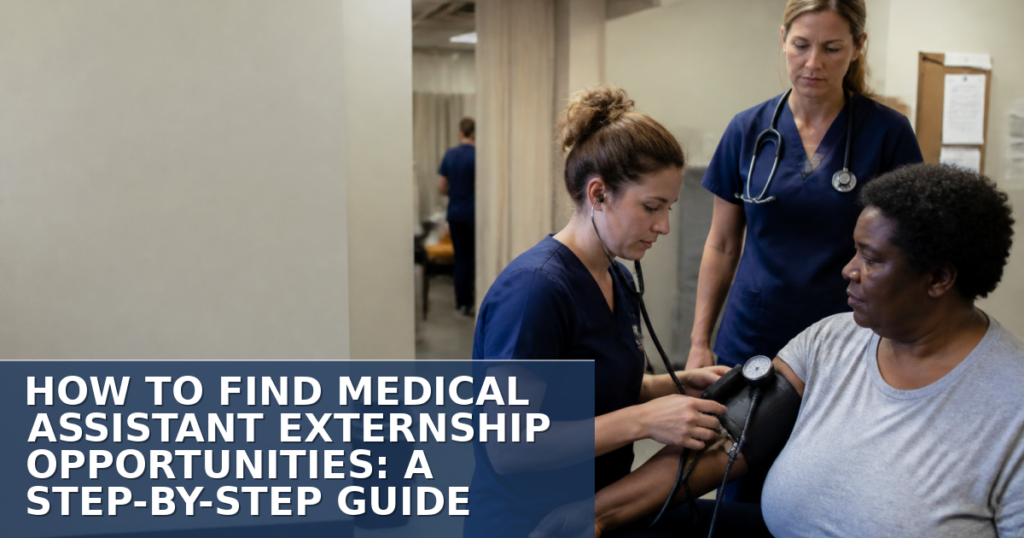
Most accredited medical assistant programs in the Dallas area require between 80 and 240 hours of supervised medical assistant externship or clinical training. This hands-on portion gives you the chance to practice phlebotomy, EKGs, injections, and front-office tasks in a real medical office or clinic. The exact number of hours depends on the school, so it is important to compare requirements before you enroll.
Programs like CHCP also include a 180-hour externship as part of a larger 900-hour curriculum.5 While 80 hours is the floor reported by some schools6, most employers expect training that meets or exceeds the 160-hour benchmark common to accredited programs.
Clinical placement sites in Dallas often include large healthcare systems like Parkland, Baylor Scott & White clinics, and private physician offices. Schools with strong clinical partnerships, such as those that guarantee placement or have dedicated coordinators, tend to make the process smoother. Always ask whether the school arranges your site or expects you to find one on your own. At Dallas College, for example, students are assigned to a site, while some shorter programs let students choose or accept a placement from the school’s network.
You typically won’t get paid during your clinical training; it’s an educational requirement, not a job. However, it is not uncommon for a high-performing extern to be offered a paid position at the same office after graduation. That can give you a head start on your job search, so it is wise to treat the externship like an extended working interview.
Before you commit, ask about the externship placement rate and process. Does the school have a dedicated clinical coordinator? What percentage of students complete their required hours on time? Are any placement sites off-limits for transportation or schedule reasons? Getting clear answers helps you avoid surprises and ensures you get the real-world practice you need to sit for certification and enter the Dallas job market with confidence.
The Bureau of Labor Statistics projects that medical assistant employment will grow 14 percent from 2022 to 2032, making it one of the fastest growing healthcare support occupations in the country. That pace is well above average for all occupations, which means strong demand for trained graduates entering the Dallas job market.
After finishing your medical assistant program, you will need to choose a certification. The three most recognized credentials are CMA (AAMA), RMA (AMT), and CCMA (NHA). This table breaks down the key differences to help you decide, though official details for RMA and CCMA are not fully verified here.
| CMA (AAMA) | RMA (AMT) | CCMA (NHA) |
|---|---|---|
| Graduation from a CAAHEP- or ABHES-accredited program; alternative pathways also exist for recertifying CMAs and educators. | Broad eligibility, including graduation from accredited programs or work experience, but official details are unverified. | Typically open to graduates of accredited programs and those with work experience, but official details are unverified. |
| 200 multiple-choice questions, 110 minutes, scaled passing score of 430 out of 500. | Not specified in available sources. | Not specified in available sources. |
| $125 | Not available | Not available |
| Required every 60 months; fee and continuing education details are on the AAMA website. | Likely required, but cycle and fee are not verified. | Likely required, but cycle and fee are not verified. |
| Programs accredited by CAAHEP or ABHES meet eligibility. | Not verified, but likely accepts graduates from both CAAHEP and ABHES programs. | Not verified, but likely accepts graduates from regionally or nationally accredited programs. |
| Texas does not legally require certification, but most Dallas employers, especially hospitals, require it. | Same | Same |
Below are the top medical assistant programs serving Dallas students, ranked by IPEDS completion data, accreditation status, and program fit. Each profile highlights key details like cost, length, and format to help you compare your options.
Dallas, TX · ~$29,000/yr (est.)
Best for: Students planning to pursue advanced healthcare degrees
Parker University in Dallas offers a Medical Assistant Certificate that blends online coursework with hands-on clinical training. The curriculum prepares students for roles in physicians’ offices, hospitals, and outpatient clinics, with an emphasis on both administrative and clinical skills. Credits from this program may transfer to advanced degrees in nursing, healthcare administration, or sonography, making it a strong stepping stone for career growth. With a 74% graduation rate, Parker provides a supportive environment for students entering healthcare.
Fort Worth, TX · $25,000 – $30,000/yr
Best for: Busy adults needing flexible, short-term training
The College of Health Care Professions in Fort Worth provides an accelerated 36-week Medical Assistant program with flexible scheduling, including one-day, two-day, and night class options. Students gain clinical skills such as taking vital signs and specimen collection, plus administrative training in medical billing and electronic health records. The program cost starts around $17,400 and includes an externship, career services, and exam preparation for the NRCMA certification. This for-profit college also offers financial aid and scholarship opportunities.
Fort Worth, TX · $2,000 – $8,000/yr
Best for: Budget-conscious students seeking CAAHEP accreditation
Tarrant County College District in Fort Worth offers a CAAHEP-accredited Medical Assistant certificate that stands out for its affordability and strong outcomes. Total program tuition is just $3,528 for 40 credit hours, making it one of the most budget-friendly options in the Dallas-Fort Worth area. The selective admission program reports an 87.3% exam passage rate and 76.8% job placement rate, and it accepts VA educational benefits. Graduates can transfer credits toward a bachelor’s degree for career advancement.
Dallas, TX · $25,000 – $30,000/yr
The College of Health Care Professions in Dallas offers the same accelerated 36-week Medical Assistant program as its Fort Worth counterpart, with flexible blended learning and multiple schedule options. Located in the Dallas area, this campus provides convenient access for students living or working in the city. The program covers clinical skills like phlebotomy and EKGs, along with administrative duties, and includes NRCMA exam preparation. Net price after aid averages $27,411, with a 62% graduation rate.
North Richland Hills, TX · $26,000/yr (net price)
Remington College’s Fort Worth campus in North Richland Hills offers a 24-month Medical Assisting Associate Degree that combines classroom instruction with a hands-on externship. The program covers clinical procedures, anatomy, pharmacology, and medical billing, and tuition includes the first attempts at CCMA and CPR certification. Net price is approximately $25,913, and the institution reports a 45% graduation rate, with a focus on preparing students for both clinical and administrative roles.
Dallas, TX · $30,000/yr
Remington College’s Dallas campus provides the same 24-month Medical Assisting Associate Degree, situated right in Dallas for easy commuting. The program balances clinical and administrative training, with an externship and certification exam costs included in tuition. Net price averages $29,805, and the curriculum covers essential topics like medical terminology, insurance billing, and patient interaction. This for-profit college offers career-focused education with a student-faculty ratio of 25:1.
Arlington, TX · $14,000/yr
The University of Texas at Arlington offers a Clinical Medical Assistant certificate through its Division of Enterprise Development, providing an affordable and flexible pathway into healthcare. At $4,500, tuition includes textbooks, scrubs, CPR, and the NHA CCMA exam, with no additional externship required for certification. Evening and Saturday classes make it ideal for working adults, and the program’s 140 classroom hours prepare students for roles in private practices, hospitals, and clinics. UT Arlington’s net price for in-state students is around $13,951.
Dallas, TX · $20,000 – $25,000/yr
Remington College’s online Medical Assisting Associate Degree allows Dallas students to complete a 24-month program remotely, combining online coursework with a required externship for hands-on experience. Tuition includes CCMA and CPR exam costs, and the curriculum covers clinical procedures, medical terminology, and billing. Net price is around $24,413, and the program is suitable for self-motivated learners who need the flexibility of online education while pursuing a career in healthcare.
Choosing a medical assistant program in Dallas brings up many practical questions. Here are straight answers to the ones we hear most often, based on current school offerings and local career data.
Medical assistant program length varies: accelerated certificate courses can be completed in 8 to 10 weeks (CalRegional)1 or 18 weeks with an externship (Dallas Medical Assistant School)2, while many diploma and associate programs run 9 to 12 months. Dallas College offers paths lasting 1 to 2 years for an associate degree3, giving students several pace options.
Tuition ranges from about $2,376 to $14,0004 for comprehensive training. For example, CalRegional costs $2,995 or less1, and Dallas College estimates in-county total tuition between $1,980 and $11,520 depending on the credential3. Many schools offer payment plans and financial aid.
Yes, you can work as a medical assistant without certification in Texas, as the state does not require a license or national certification.5 However, most Dallas-area employers strongly prefer or require a credential like the CMA, RMA, or CCMA. Earning certification not only improves job prospects but also can lead to higher pay and career advancement.
Nearly all reputable programs include a clinical externship. Dallas Medical Assistant School, for instance, mandates an 80-hour externship2, and schools like PCI also build hands-on training into their curriculum. These experiences let students apply skills in real clinics or physician offices, often leading to job offers after graduation.
The medical assistant salary in Dallas starts around $35,000 per year for entry-level roles.6 Once established, the average annual wage reaches about $44,030.7 Your actual pay will depend on employer type, credentials, and experience, but the local market offers solid growth potential for new graduates.